Skip to content
中文

CHINA · Cultural Monograph

Chinese Tea Culture: Literati Aesthetics, Gongfu Craft, and Everyday Teahouses

Homeland of six tea families, spanning daily necessity and philosophical reflection across regional landscapes

As tea's botanical cradle and the birthplace of all six major processing families, China never confined tea to a single codified rite: it spans Tang-Song aesthetics, Ming-Qing literati studios, Chaoshan Gongfu tables, bustling Sichuan teahouses, and vibrant multi-ethnic mountain customs.

Key Cultural Terminology

工夫茶 (Gōngfu chá)
Originating in Chaoshan and southern Fujian, a high-ratio, rapid-infusion practice emphasizing meticulous attention to water heat, timing, and hospitality.
盖碗 (Gàiwǎn (San-cai bowl))
The three-piece lidded bowl ('Heaven-Earth-Humanity') prized both for solo sipping and for faithful, non-absorptive professional tasting.
禅茶一味 (Chán chá yī wèi)
Monastic Chan tradition uniting waking attentiveness with everyday mindfulness, echoed in Master Zhaozhou's famous refrain: 'Go have a cup of tea.'
茶馆 (Cháguǎn)
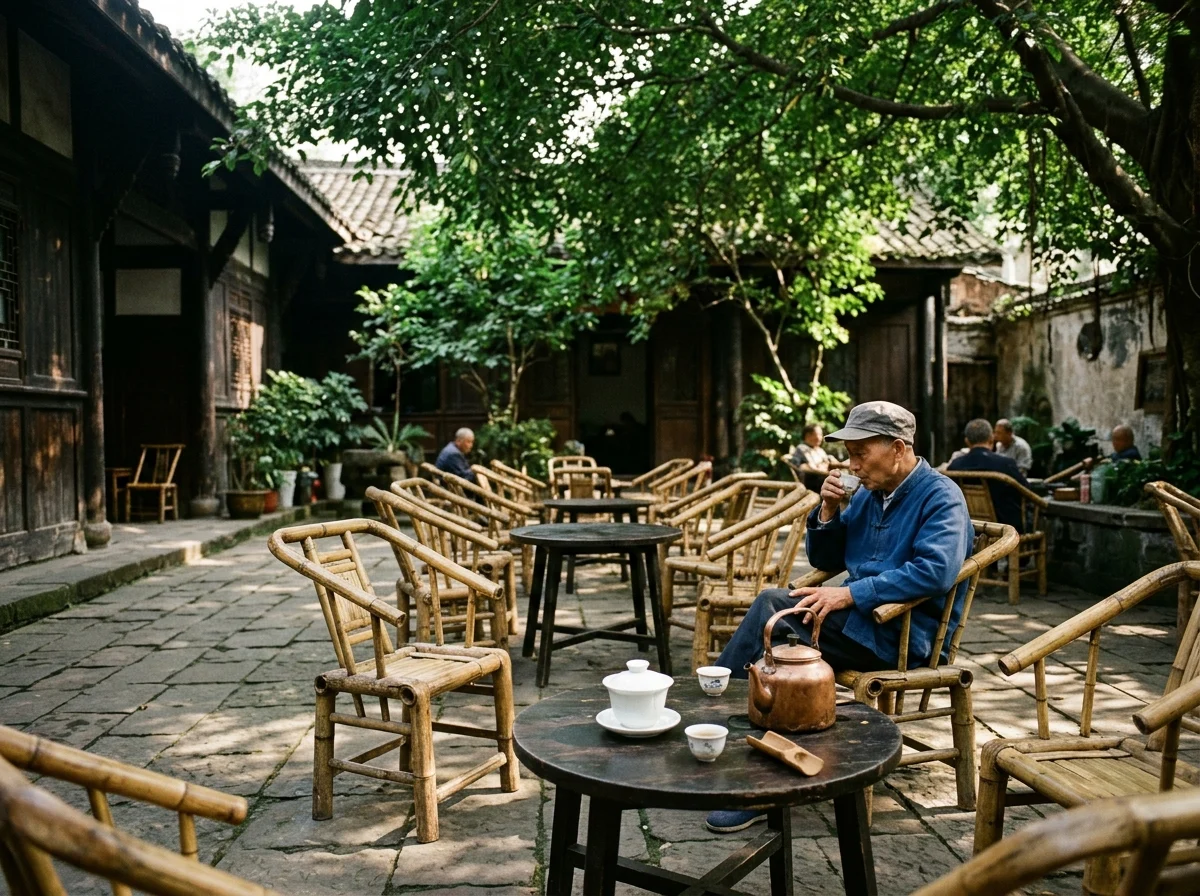
Neighborhood public living rooms—exemplified by Sichuan's bamboo-chair teahouses—hosting conversation, storytelling, and informal civic mediation.
Traditional Sichuan courtyard teahouse with bamboo chairs, white porcelain gaiwan, and copper kettle
Curatorial Visual (AI Generated)
Sichuan Courtyard Teahouse: bamboo armchairs and lidded gaiwan bowls anchor everyday civic sociability.Curatorial Cultural Scene (AI Generated)
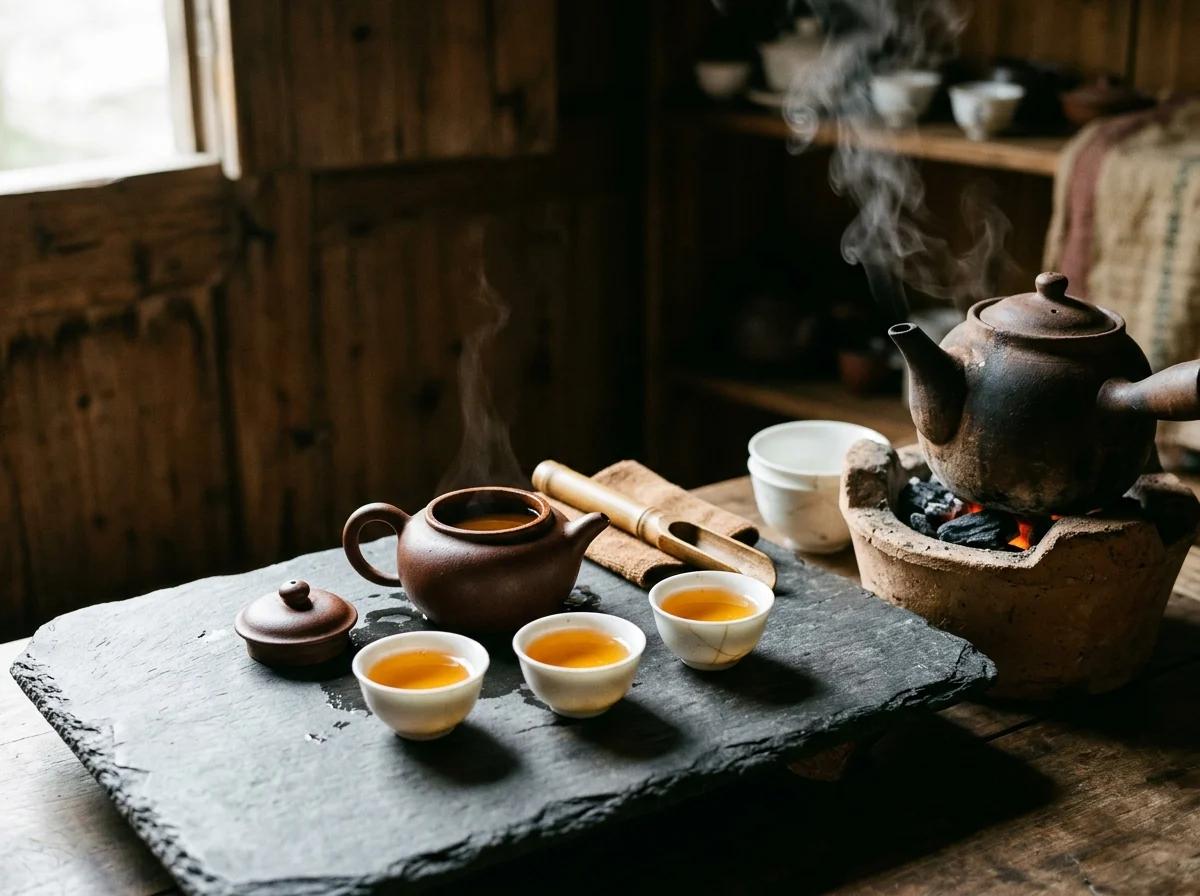
Chaoshan Gongfu tea tray with small red clay teapot, three thin porcelain cups, and rising steam
Curatorial Visual (AI Generated)
Chaoshan Gongfu Tea: high leaf-to-water ratio and three delicate porcelain cups turn precision into hospitality.Curatorial Cultural Scene (AI Generated)
Historical Record

Tang–Song Aesthetics, Literati Studios, and Monastic Discipline

From Lu Yu's Chajing and Tang monastic codes ('Baizhang Qinggui') onward, tea served both sensory refinement and contemplative discipline. Song scholars honed connoisseurship through whisked tea contests and black Jian ware, while after the 1391 loose-leaf shift, Ming–Qing literati paired spring water, Yixing zisha teapots, and garden gatherings into a portable art of quiet companionship.

Curatorial Analysis

Chaoshan Gongfu Tea: Precision, Heat, and Warm Hospitality

In Chaoshan and southern Fujian, Gongfu tea anchors daily hospitality, family life, and business negotiations. Artisans pack small clay pots or porcelain gaiwans generously with wulong leaves, pour boiling water from a high arc to lift aroma, and distribute liquor evenly across tiny cups ('Guan Gong patrolling the city') so every guest receives identical strength and warmth.

Curatorial Analysis

Sichuan Teahouses: Civic Third Places Under Bamboo Canopy

Across Chengdu and the Sichuan basin, open-air teahouses act as egalitarian civic living rooms. Guests settle into bamboo armchairs with lidded porcelain gaiwans of jasmine or green tea replenished by acrobatic long-spouted copper kettles, creating lively venues for neighborhood chatter, opera, and even traditional 'talking-tea' dispute mediation.

Curatorial Analysis

Yunnan & Multi-Ethnic Traditions and Daily Life

In Yunnan's ancient tea forests and across southwest highlands, Bulang, Dai, Hani, Bai, Yao, and Tibetan communities sustain diverse living traditions—bamboo-roasted tea, charcoal-simmered pot tea, Bai Three-Course Tea ('first bitter, second sweet, third reflective'), and savory Yao oil tea. Nationally, tea remains one of the 'seven daily necessities' while simultaneously inspiring contemporary specialty tea bars.

Verified References & Provenance

  1. [01] c. 760–780Source

    The Classic of Tea (Chajing) by Lu Yu

    Lu Yu (c. 760–780 CE)

    The earliest surviving systematic monograph on tea, organized into ten chapters covering origins, tools, processing, vessels, boiling, drinking, historical anecdotes, regions, omissions, and scroll diagrams.

  2. [02] 2022Source

    Traditional tea processing techniques and associated social practices in China

    UNESCO Intangible Cultural Heritage · Nomination File No. 01884

    Inscribed in 2022; documents the six core Chinese tea categories, reprocessed teas, and their embedded social rituals across 44 national heritage items.

  3. [03] 1979Source

    Chen Chuan's Six-Category Tea Classification (1979) & Camellia sinensis Phylogeography

    Chen Chuan (1979) / Chen Zongmao (ed., China Tea Classic)

    Chen Chuan (1979) established the modern scientific taxonomy of six tea families based on processing mechanisms (enzyme inactivation, withering, yellowing, semi-oxidation, full oxidation, microbial piling) rather than linear fermentation; Chen Zongmao's China Tea Classic synthesizes modern agronomy and tea chemistry.

  4. [04] 2009Source

    The True History of Tea

    Victor H. Mair & Erling Hoh

    Philological and historical synthesis tracing tea from southwest China/Southeast Asia across overland 'cha' and maritime 'te' linguistic and trade corridors.