Skip to content
中文

WORLD · Cultural Monograph

India's Masala Chai: Roadside Chaiwalas, Spiced Milk Decoction, and Reinvention

How railway vendors and home kitchens transformed an export-oriented plantation crop into India's most democratic daily drink

Though Singpho communities brewed indigenous Assam leaf long before British arrival, colonial estates ignored local drinkers in favor of London auctions. Only in the early 20th century—when domestic campaigns met roadside vendors boiling affordable CTC tea dust with milk, sugar, and spices—did modern Masala Chai sweep the subcontinent.

Key Cultural Terminology

चाय / Chai (Chai (Masala Chai))
Black CTC tea boiled directly with milk, sugar, and warming spices such as ginger, green cardamom, cloves, and cinnamon.
कुल्हड़ / Kulhad (Kulhad)
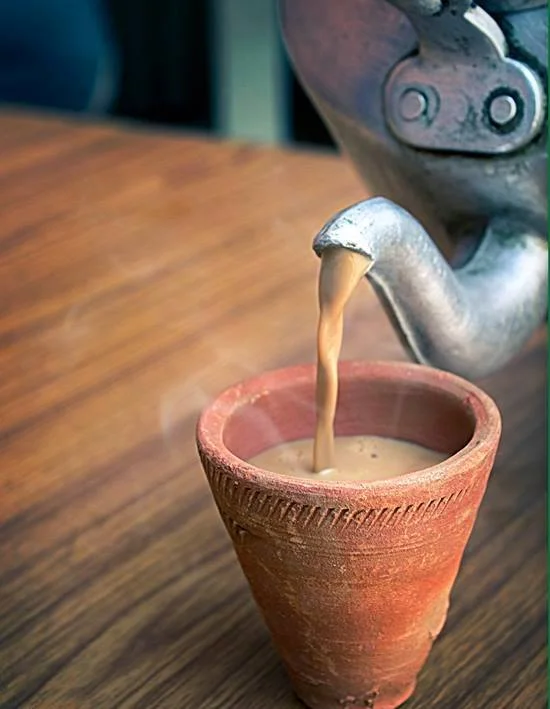
Unglazed disposable earthenware cup whose porous clay imparts a subtle petrichor note to hot chai before returning to earth.
Chaiwala (Chaiwala)
Neighborhood or railway tea-maker whose simmering kettle anchors vibrant, cross-class street conversation.
Indian spiced Masala Chai served in a terracotta kulhar cup
CC BY-SA 4.0 · Wikimedia Commons
Indian Masala Chai: CTC Assam simmered with milk, sugar, cardamom, and ginger in disposable earthen kulhar cups.Dadhichbittu007 · Wikimedia Commons (CC BY-SA 4.0) · Source
Historical Record

From Export Tea Dust to Railway-Platform Invention

When early 1900s campaigns initially failed to sell orthodox leaf domestically, entrepreneurial railway and street vendors adapted: they boiled inexpensive, brisk Assam CTC fannings directly in milk and water with jaggery or sugar plus crushed ginger, cardamom, and cloves—turning harsh tannins into a restorative, aromatic emulsion.

Curatorial Analysis

Regional Spice Vocabularies and Kulhad Sociability

There is no single recipe: Mumbai favors fiery crushed ginger (adrak chai); Gujarat and Maharashtra add lemongrass or mint; and Kashmir maintains distinct saffron-almond Kahwa and pink salted Noon Chai. Standing curbside with a steaming clay kulhad remains an egalitarian ritual across every Indian city.

Verified References & Provenance

  1. [01] 2020Source

    Tea War: A History of Capitalism in China and India

    Andrew B. Liu · 10.12987/yale/9780300243734.001.0001

    Yale University Press comparative history of Huizhou, Wuyi, and Assam, showing how both colonial penal indenture and Chinese piece-rate time discipline constituted dynamic Asian capitalist accumulation.

  2. [02] 2017Source

    A Thirst for Empire: How Tea Shaped the Modern World

    Erika Rappaport · ISBN 9780691167114

    Princeton University Press study demonstrating how temperance movements, imperial propaganda, branding, and corporate integration (such as Lipton) manufactured British imperial tea taste.

  3. [03] 2025Source

    International Tea Committee (ITC) & National Tea Boards (Kenya, India, Sri Lanka) 2024–2025 Export Data

    ITC / Tea Board of Kenya / Sri Lanka Tea Board / Tea Board India

    Aggregates 2024–2025 national export benchmarks: Kenya ~652.8k t (~$2.20–$2.27/kg bulk CTC); Sri Lanka ~258k t (~$5.50–$5.83/kg orthodox/value-added); India ~257.9k t (~$3.40/kg).

  4. [04] 2021Source

    Royal Botanic Gardens, Kew: The History of Tea from China to India

    Royal Botanic Gardens, Kew

    Traces botanical classification of Camellia sinensis var. assamica, Wardian-case plant transport, and Kew's role in colonial botanical networks.