Skip to content
中文

JAPAN · Cultural Monograph

Japanese Chado (Chanoyu): Zen Matcha, Wabi-Cha Masters, Spatial Poetics, and Politics

Preserving powdered whisked tea and forging it into a total art of architecture, roji gardens, ceramics, and disciplined hospitality

Japanese Chado is no timeless museum piece: sparked by Eisai's Zen tea transmission, revolutionized from imported luxury to wabi simplicity by Murata Jukō, Takeno Jōō, and Sen no Rikyū, it also served as an arena of samurai power, social hierarchy, and modern cultural identity.

Key Cultural Terminology

和敬清寂 (Wa-Kei-Sei-Jaku)
The four foundational principles of Chado—Harmony, Respect, Purity, and Tranquility—guiding host and guest alike.
一期一会 (Ichigo Ichie)
'One time, one meeting': every tea gathering is unrepeatable, demanding complete sincerity from both host and guests.
侘び寂び (Wabi-sabi)
Aesthetic sensibility finding depth in austere simplicity (wabi) and weathered impermanence (sabi) rather than ostentatious perfection.
茶碗·茶筅·茶杓·釜 (Chawan · Chasen · Chashaku · Kama)
Essential implements: the hand-built chawan bowl, carved bamboo chasen whisk, bamboo chashaku scoop, and cast-iron kama kettle.
茶室 · 露地 (Chashitsu & Roji)
The dewy garden path (roji) leading to the tearoom's low crawling entrance (nijiriguchi), where visitors bow equally regardless of rank.
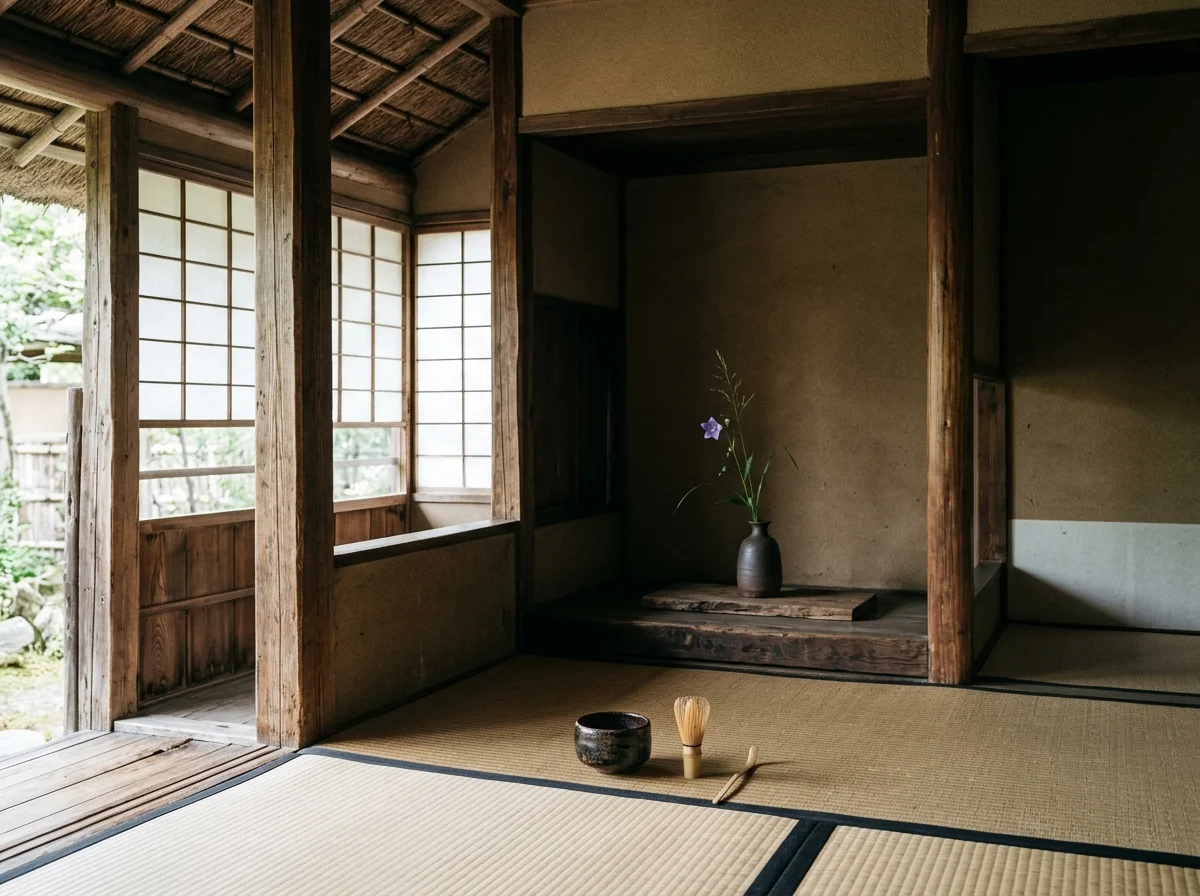
Traditional Japanese chashitsu tea room with tatami, shoji paper screens, chabana, and matcha bowl
Curatorial Visual (AI Generated)
Japanese Chashitsu: diffused shoji light, single-stem chabana, and handmade chawan define wabi proportion.Curatorial Architectural Study (AI Generated)
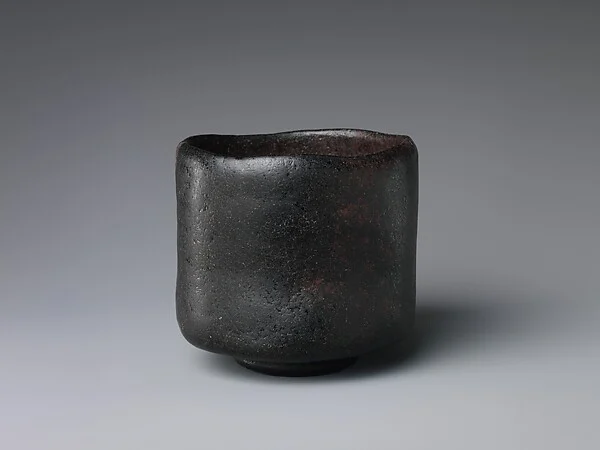
Momoyama/early Edo Black Raku tea bowl (The Met)
Museum Open Access · CC0 · The Met
Early 17th-c. Black Raku chawan; hand-molded without a potter's wheel, embodying Sen no Rikyū's wabi aesthetic.The Metropolitan Museum of Art (CC0 Open Access) · Accession: Met 62898 (17.118.74) · Source
Historical Record

Lineage of Transformation: Eisai, Jukō, Jōō, and Sen no Rikyū

Following Eisai's 1211 treatise, Muromachi elites first prized lavish Chinese karamono utensils in grand shoin halls. In the late 15th century, Murata Jukō began pairing imported treasures with rustic domestic Shigaraki and Bizen ceramics; Sakai merchant Takeno Jōō infused poetic restraint; and Sen no Rikyū (1522–1591) perfected wabi-cha—collaborating with potter Chōjirō on hand-molded black Raku chawan and shrinking the tearoom to the two-mat Tai-an hut.

Curatorial Analysis

Total Spatial Poetics: Chashitsu, Roji, Chabana, Calligraphy, and Seasonality

A formal chaji engages architecture, horticulture, and seasonality in unison. Guests walk the mossy roji garden, rinse hands at a stone basin, and stoop through the low nijiriguchi into a quiet chashitsu. A Zen calligraphic scroll (bokuseki) and a single unpretentious seasonal flower arrangement (chabana) set the gathering's theme, accompanied by the 'wind-in-the-pines' simmer of the iron kama and seasonal shifts between summer portable braziers and winter sunken hearths.

Scholarly Interpretation

Power, Samurai Politics, Social Identity, and Okakura's Legacy

Far from apolitical, Chanoyu stood at the heart of early modern statecraft. Warlord Oda Nobunaga rationed prized tea utensils and tea-hosting licenses to bind vassals; Toyotomi Hideyoshi staged both the mass 1587 Kitano Grand Tea Gathering and a portable golden tearoom before ordering Sen no Rikyū's ritual suicide in 1591. Later codified under Edo-period iemoto schools, Chado was reframed globally by Okakura Kakuzō's 1906 The Book of Tea and evolved into a vital modern medium of community, craft preservation, and social identity.

Verified References & Provenance

  1. [01] 1211Source

    Kissa Yōjōki (Drinking Tea for Health, 1211) by Myōan Eisai

    Myōan Eisai (1141–1215)

    Japan's earliest extant tea treatise (1211), introducing Song-style powdered tea cultivation and preparation alongside Zen monastic practice.

  2. [02] 2024Source

    Urasenke Official Introduction to Chado (The Way of Tea)

    Urasenke Foundation

    Authoritative overview of Chado lineage from Sen no Rikyū, the four principles Wa-Kei-Sei-Jaku, and modern tea gathering choreography.

  3. [03] 2023Source

    The Metropolitan Museum of Art: The Japanese Tea Ceremony

    The Metropolitan Museum of Art

    Heilbrunn Timeline essay examining the transition from prized Chinese karamono utensils to wabi-cha Raku wares and bamboo scoops.

  4. [04] 1906Source

    The Book of Tea

    Okakura Kakuzō · Project Gutenberg #769

    Published in English in 1906 across seven chapters while Okakura curated Asian art at the Museum of Fine Arts, Boston; interprets Teaism, Taoist/Zen aesthetics, the chashitsu, and tea masters.