Skip to content
中文

WORLD · Cultural Monograph

Korean Darye: Mountain Temples, Ven. Choui, and Unpretentious Everyday Harmony

Treading a distinctive path between courtly ritual and rustic spontaneity, anchored in wild mountain teas and warm celadon-to-buncheong wares

Flourishing under Silla and Goryeo Buddhist patronage before retreating to southern mountain monasteries during the mid-Joseon era, Korean tea was revitalized in the 19th century by scholars like Dasan Jeong Yak-yong and Ven. Choui—yielding a gentle, unpretentious aesthetic known as Darye.

Key Cultural Terminology

다례 / 茶禮 (Darye ('Etiquette for Tea'))
Literally 'tea etiquette'—encompassing both unhurried everyday hospitality (saenghwal darye) and ancestral or temple tea offerings.
우전 / 雨前 (Ujeon)
Prized first-flush green tea plucked before Gogu (late April) in Hadong or Boseong, gently pan-fired in cast-iron cauldrons.
중정 / 中正 (Jungjeong (Balance))
Ven. Choui's 1837 ideal in Dongdasong: harmony of water, fire, leaf, and vessel without artificial ostentation.
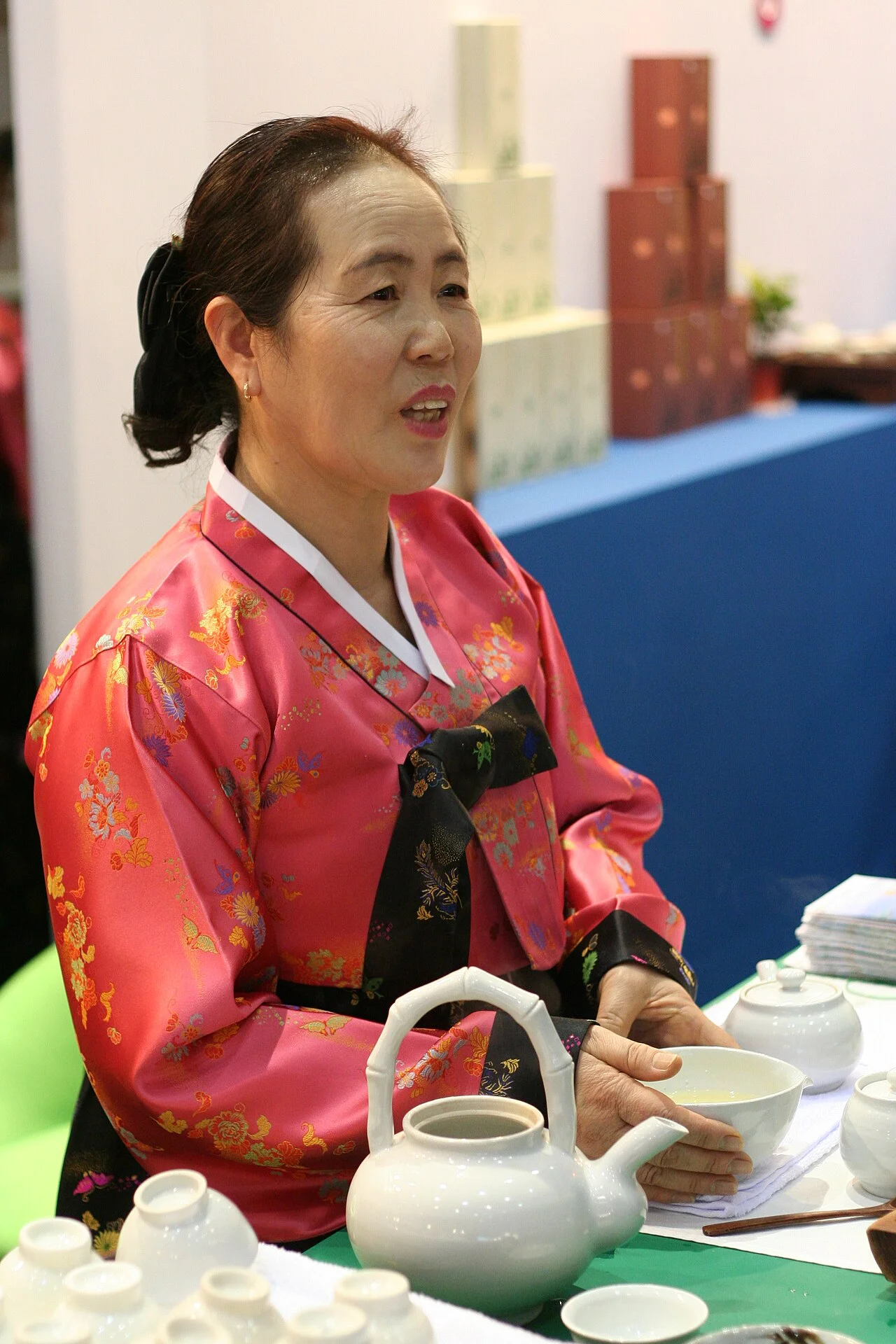
Korean traditional tea ceremony (Darye) pouring tea
CC BY-SA 2.0 · Wikimedia Commons
Korean Darye: grounded in understated natural warmth and mindful shared conversation rather than rigid theatricality.hojusaram · Wikimedia Commons (CC BY-SA 2.0) · Source
Historical Record

Monastic Roots and the 19th-Century Choui Revival

Historical chronicles record tea seeds planted on Mount Jiri (Hadong) in 828 CE during the Silla dynasty, flourishing in Goryeo royal and temple 'tea bureaus' alongside inlaid celadon wares. After shifting southward to monastic retreats under the Joseon dynasty, tea culture experienced a luminous 19th-century renaissance led by exiled philosopher Dasan Jeong Yak-yong and Ven. Choui, whose 1837 verse classic Dongdasong ('Hymn of Eastern Tea') defined Korean tea philosophy.

Curatorial Analysis

Hadong & Boseong Terraces and Warm Everyday Darye

Today's Korean tea heartlands span Hadong's ancient wild-forest agroforestry (a FAO GIAHS heritage system), Boseong's sculpted terraced hills, and volcanic Jeju Island. In modern Darye practice, hosts cool boiling water in a spouted sugu cooling bowl before steeping delicate pan-fired Ujeon or Sejak green tea and mild oxidized balhyocha, serving guests in tactile buncheong or white porcelain cups with relaxed warmth.

Verified References & Provenance

  1. [01] 2009Source

    The True History of Tea

    Victor H. Mair & Erling Hoh

    Philological and historical synthesis tracing tea from southwest China/Southeast Asia across overland 'cha' and maritime 'te' linguistic and trade corridors.

  2. [02] 1979Source

    Chen Chuan's Six-Category Tea Classification (1979) & Camellia sinensis Phylogeography

    Chen Chuan (1979) / Chen Zongmao (ed., China Tea Classic)

    Chen Chuan (1979) established the modern scientific taxonomy of six tea families based on processing mechanisms (enzyme inactivation, withering, yellowing, semi-oxidation, full oxidation, microbial piling) rather than linear fermentation; Chen Zongmao's China Tea Classic synthesizes modern agronomy and tea chemistry.