Skip to content
中文

WORLD · Cultural Monograph

Taiwanese Tea Culture: High-Mountain Oolong, Oriental Beauty, and Contemporary Tea Arts

Tracing Fujian-rooted cultivars as they evolved into high-elevation alpine oolongs, leafhopper-bitten honey teas, and modern 'Chayi' tearoom design

While Qing-era pioneers brought tea cultivars from Fujian across the strait, Taiwan forged an extraordinarily inventive tea culture of its own—pioneering high-mountain alpine oolongs, charcoal-roasted Dongding, ecological leafhopper-bitten Oriental Beauty, and the modern 'Chayi' tea-house movement that reshaped contemporary East Asian tea aesthetics.

Key Cultural Terminology

高山乌龙 (Gāoshān Wūlóng)
Lightly oxidized, ball-rolled alpine oolongs grown above 1,000 meters (Alishan, Shanlinxi, Lishan), prized for floral lift and creamy broth.
东方美人 (Dōngfāng Měirén (Pēngfēng chá))
Heavy-oxidized tippy oolong triggered by tiny green leafhoppers biting young shoots in pesticide-free gardens, yielding natural honey and muscatel aroma.
茶艺 · 闻香杯 (Cháyì & Wénxiāngbēi)
1970s–80s Taiwanese tea-arts movement pairing minimalist table staging (chaxi) with paired tall sniffing cups (wenxiangbei) and tasting cups.
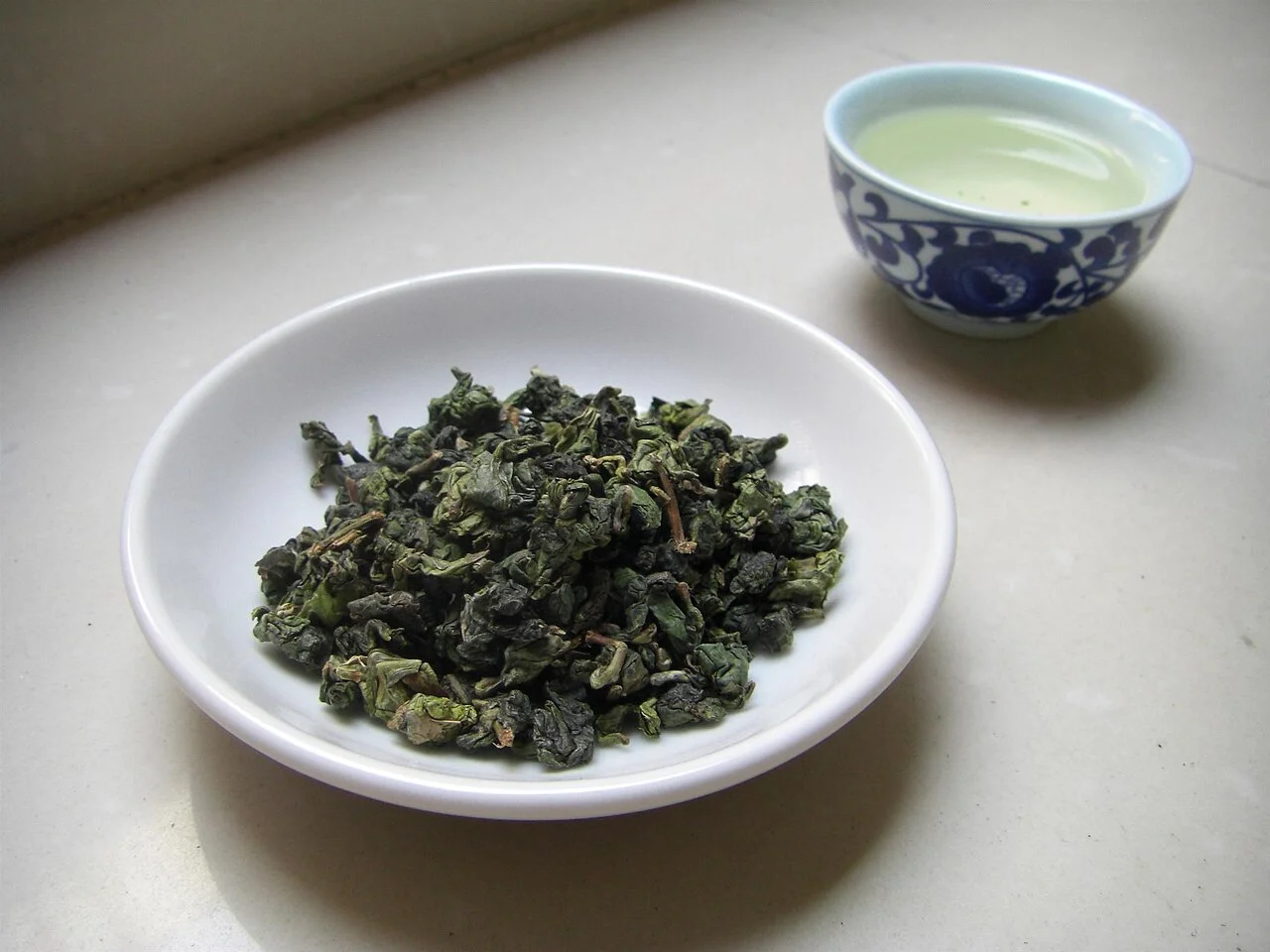
Tightly rolled Anxi Tieguanyin oolong tea leaves photograph
Museum Open Access · CC0 · Wikimedia Commons
Oolong Specimen (Tieguanyin): partially oxidized, cloth-rolled into dense olive-green spheres.Quelcrime · Wikimedia Commons (Public Domain) · Source
Historical Record

Terroir and Craft: Roasted Dongding, Alpine Oolongs, and Oriental Beauty

Taiwanese oolong makers specialize in micro-calibrated withering, bruising, and roasting. Lugu's classic Dongding oolong balances medium oxidation with patient roasting for nutty, stone-fruit depth; alpine plantations opened since the 1970s across Alishan, Shanlinxi, and Lishan yield lightly oxidized, sweet-creamy 'High-Mountain' teas; and Hakka-region Oriental Beauty turns tiny green leafhopper bites in organic gardens into extraordinary muscatel honey complexity.

Curatorial Analysis

The Chayi Movement, Tea Houses, and Global Bubble Tea Innovation

During the 1970s–1980s, Taiwanese tea artists and ceramicists coined 'Chayi' (Tea Art)—opening iconic urban tearooms like Wistaria Tea House, introducing paired sniffing cups, and collaborating with studio potters to elevate everyday gongfu brewing into contemporary spatial design. Simultaneously, Taiwanese street tea shops pioneered shaken foam tea and tapioca bubble tea in the 1980s, sparking a worldwide revolution in modern beverage culture.

Verified References & Provenance

  1. [01] 1979Source

    Chen Chuan's Six-Category Tea Classification (1979) & Camellia sinensis Phylogeography

    Chen Chuan (1979) / Chen Zongmao (ed., China Tea Classic)

    Chen Chuan (1979) established the modern scientific taxonomy of six tea families based on processing mechanisms (enzyme inactivation, withering, yellowing, semi-oxidation, full oxidation, microbial piling) rather than linear fermentation; Chen Zongmao's China Tea Classic synthesizes modern agronomy and tea chemistry.

  2. [02] 2022Source

    Traditional tea processing techniques and associated social practices in China

    UNESCO Intangible Cultural Heritage · Nomination File No. 01884

    Inscribed in 2022; documents the six core Chinese tea categories, reprocessed teas, and their embedded social rituals across 44 national heritage items.

  3. [03] 2009Source

    The True History of Tea

    Victor H. Mair & Erling Hoh

    Philological and historical synthesis tracing tea from southwest China/Southeast Asia across overland 'cha' and maritime 'te' linguistic and trade corridors.