Skip to content
中文

WORLD · Cultural Monograph

Tibetan Butter Tea (Po Cha): High-Altitude Nourishment and Deep Archaeological Roots

An emulsified fusion of boiled brick tea, yak butter, and salt sustaining warmth, hydration, and monastic community across the roof of the world

Confirmed by 2nd–3rd century CE tea buds at Gurgyam Cemetery, tea's presence on the Tibetan Plateau predates Tang records by centuries. Churned with yak butter and salt, po cha transforms compressed brick tea into high-calorie warmth, essential nourishment alongside tsampa barley, and the centerpiece of monastic and home hospitality.

Key Cultural Terminology

བོད་ཇ / Po Cha (Po Cha (Sūyóuchá))
Tibetan butter tea: deeply simmered dark brick-tea decoction churned vigorously with yak butter and salt into a savory broth.
མདོང་མོ / Dongmo (Dongmo)
Tall cylindrical wooden tea churn bound with brass hoops, used to emulsify hot tea, butter, and salt.
མང་ཇ / Mangja (Mangja)
Communal monastic tea service poured down rows of chanting monks during assemblies and debates.
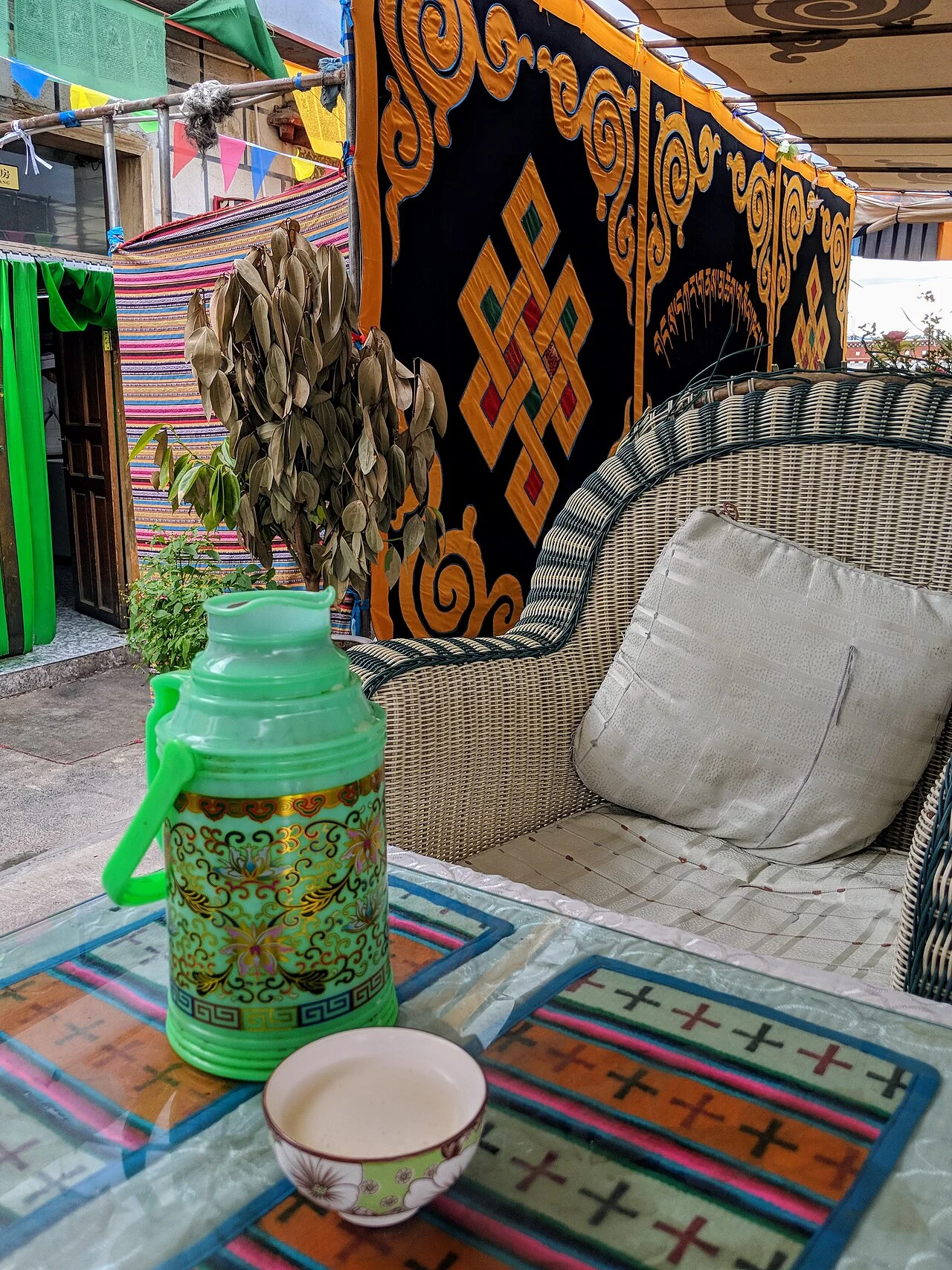
Tibetan butter tea bowl and thermos in a traditional teahouse
CC BY-SA 4.0 · Wikimedia Commons
Tibetan Butter Tea: boiled dark brick tea churned with yak butter and salt—vital warmth and lipids at high altitude.Jpatokal · Wikimedia Commons (CC BY-SA 4.0) · Source
Curatorial Analysis

Highland Ecology and Churning Craft

At high altitude where fresh produce is scarce and fat-rich dairy and meat dominate, boiled brick tea supplies vital micronutrients and aids digestion. Cooks simmer crushed dark brick tea into a concentrated extract (chakhu), strain it into a dongmo churn with fresh yak butter and salt, and plunge vigorously until oil and tea emulsify into a velvety soup ideal for mixing with roasted barley tsampa.

Curatorial Analysis

Hospitality Refills, Sweet Tea Houses, and Tea-Horse Legacies

Tibetan hospitality demands a constantly topped-up cup: hosts refill after every sip until a departing guest finishes the last drop. Alongside classic savory po cha and monastic mangja, 20th-century Lhasa also embraced sweet milk tea (cha ngarmo), giving rise to bustling neighborhood sweet-tea houses where friends gather over thermoses and conversation.

Verified References & Provenance

  1. [01] 2016Source

    Earliest tea as evidence for one branch of the Silk Road across the Tibetan Plateau

    Houyuan Lu, Jianping Zhang, Yimin Yang, Dorian Q. Fuller et al. · 10.1038/srep18955

    Uses calcium phytolith micromorphology and UPLC-MS/GC-MS detection of caffeine and L-theanine to verify tea buds in Han Yangling Mausoleum (c. 141 BCE) and Gurgyam Cemetery, western Tibet (2nd–3rd c. CE).

  2. [02] 2009Source

    The True History of Tea

    Victor H. Mair & Erling Hoh

    Philological and historical synthesis tracing tea from southwest China/Southeast Asia across overland 'cha' and maritime 'te' linguistic and trade corridors.

  3. [03] 2022Source

    Traditional tea processing techniques and associated social practices in China

    UNESCO Intangible Cultural Heritage · Nomination File No. 01884

    Inscribed in 2022; documents the six core Chinese tea categories, reprocessed teas, and their embedded social rituals across 44 national heritage items.