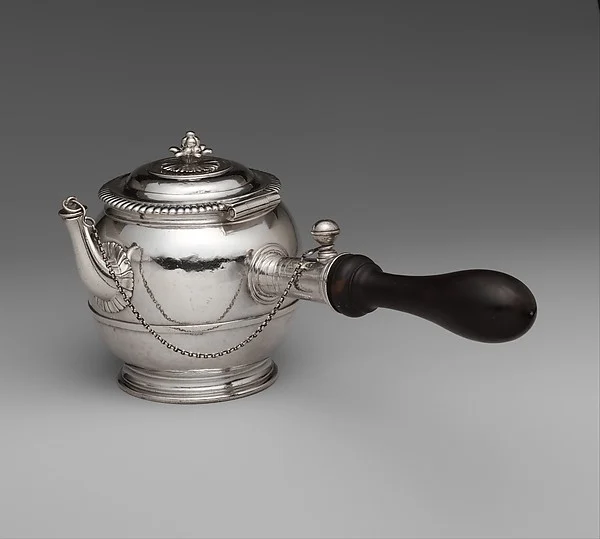
Material Annotation · Yixing-Inspired Pear-Shaped Silver Body
Early English silver silhouettes borrowed directly from small imported Chinese stoneware pots before evolving taller forms.
1699 English Silver vs. 21st-Century Studio Wood-Fired Ceramics
Georgian Silver Teapot & Contemporary Wood-Fired Stoneware
Pairing a 1699 London silver teapot with a contemporary wood-fired clay pot spans three centuries of tea materiality—from aristocratic silver display at the dawn of British tea fashion to today's quiet return to raw kiln-scarred earth.
- Origin
- London silversmiths / Contemporary wood-fired studio pottery
- Material
- Wrought sterling silver with wooden handle; coarse raw stoneware with natural wood-ash glaze
- Dimensions
- Early pear-shaped silver pot (Met #200114) contrasted with studio wood-fired teapot
- Collection
- The Metropolitan Museum of Art Open Access (CC0) / Wikimedia Commons (CC BY 2.0)
Craft & Materiality
When tea was an expensive luxury in 1699 England, silversmiths adapted Chinese pear silhouettes into mirror-polished sterling with turned wooden handles to block thermal conduction. Contemporary studio potters invert that polish: firing raw grogged clay in wood kilns for days so flying ash melts into unpredictable scorched skins.
Usage Context
Georgian silver teapots anchored drawing-room sociability and domestic prestige alongside locked tea caddies, whereas contemporary wood-fired stoneware belongs to unhurried countertop brewing and tactile studio craft.
Aesthetics & Patina
Silver pursues mirror reflection and timeless status; wood-fired clay embraces ash, grit, and one-off kiln accidents. Together they show that tea vessels always sculpt the values of their era.
Verified References & Provenance
- [01] 2026Source
The Metropolitan Museum of Art Open Access Collection (CC0)
The Metropolitan Museum of Art
Provides CC0 Public Domain imagery and provenance data for Jian ware, Yue ware, Yixing stoneware, Raku chawan, and Georgian silver teapots.
- [02] 2017Source
A Thirst for Empire: How Tea Shaped the Modern World
Erika Rappaport · ISBN 9780691167114
Princeton University Press study demonstrating how temperance movements, imperial propaganda, branding, and corporate integration (such as Lipton) manufactured British imperial tea taste.