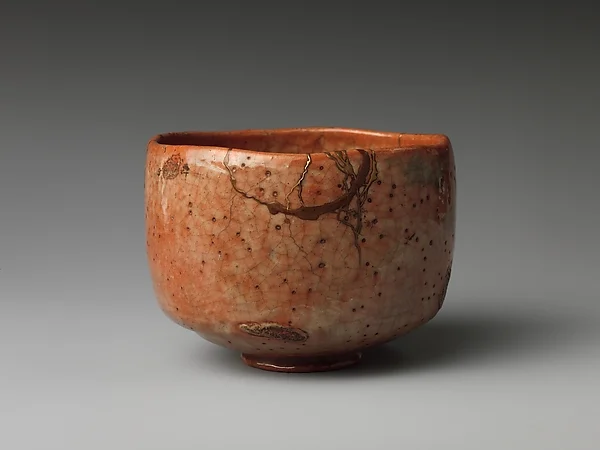
Material Annotation · Gold-Dusted Urushi Lacquer Seam
Tree-sap urushi seals the break watertight, while gold dusting highlights rather than conceals the fracture.
Edo Period (17th–19th century)
Japanese Red Raku Tea Bowl with Gold Lacquer Repair (Kintsugi)
Warm ochre-terracotta Red Raku pairs with visible kintsugi lacquer repairs—transforming accidental fracture from a disqualifying flaw into an honest biographical seam across the bowl's life.
- Origin
- Kyoto (Aka Raku) & Seto ceramic traditions, Japan
- Material
- Low-fired red earthenware under clear glaze, repaired with urushi lacquer and gold powder
- Dimensions
- Red Raku chawan paired with Seto chaire caddy reference (Met #63180 / #62554)
- Collection
- The Metropolitan Museum of Art Open Access (CC0)
Craft & Materiality
Oxidized firing of iron-bearing clay yields Red Raku's warm blush. When delicate earthenware cracked over centuries of gatherings, specialists sealed fissures with tree-sap urushi lacquer dusted in gold powder—restoring watertight utility without hiding damage.
Usage Context
In tea gatherings, a mended bowl recorded in provenance box inscriptions commands deep respect—much like silk-pouched Seto tea caddies whose wear and repair testify to generations of careful handling.
Aesthetics & Patina
Beyond modern clichés, kintsugi was rooted in practical conservation using durable urushi sap: choosing painstaking repair over disposal turned fragility and repair labor into visible dignity.
Verified References & Provenance
- [01] 2026Source
The Metropolitan Museum of Art Open Access Collection (CC0)
The Metropolitan Museum of Art
Provides CC0 Public Domain imagery and provenance data for Jian ware, Yue ware, Yixing stoneware, Raku chawan, and Georgian silver teapots.
- [02] 2023Source
The Metropolitan Museum of Art: The Japanese Tea Ceremony
The Metropolitan Museum of Art
Heilbrunn Timeline essay examining the transition from prized Chinese karamono utensils to wabi-cha Raku wares and bamboo scoops.
- [03] 1906Source
The Book of Tea
Okakura Kakuzō · Project Gutenberg #769
Published in English in 1906 across seven chapters while Okakura curated Asian art at the Museum of Fine Arts, Boston; interprets Teaism, Taoist/Zen aesthetics, the chashitsu, and tea masters.