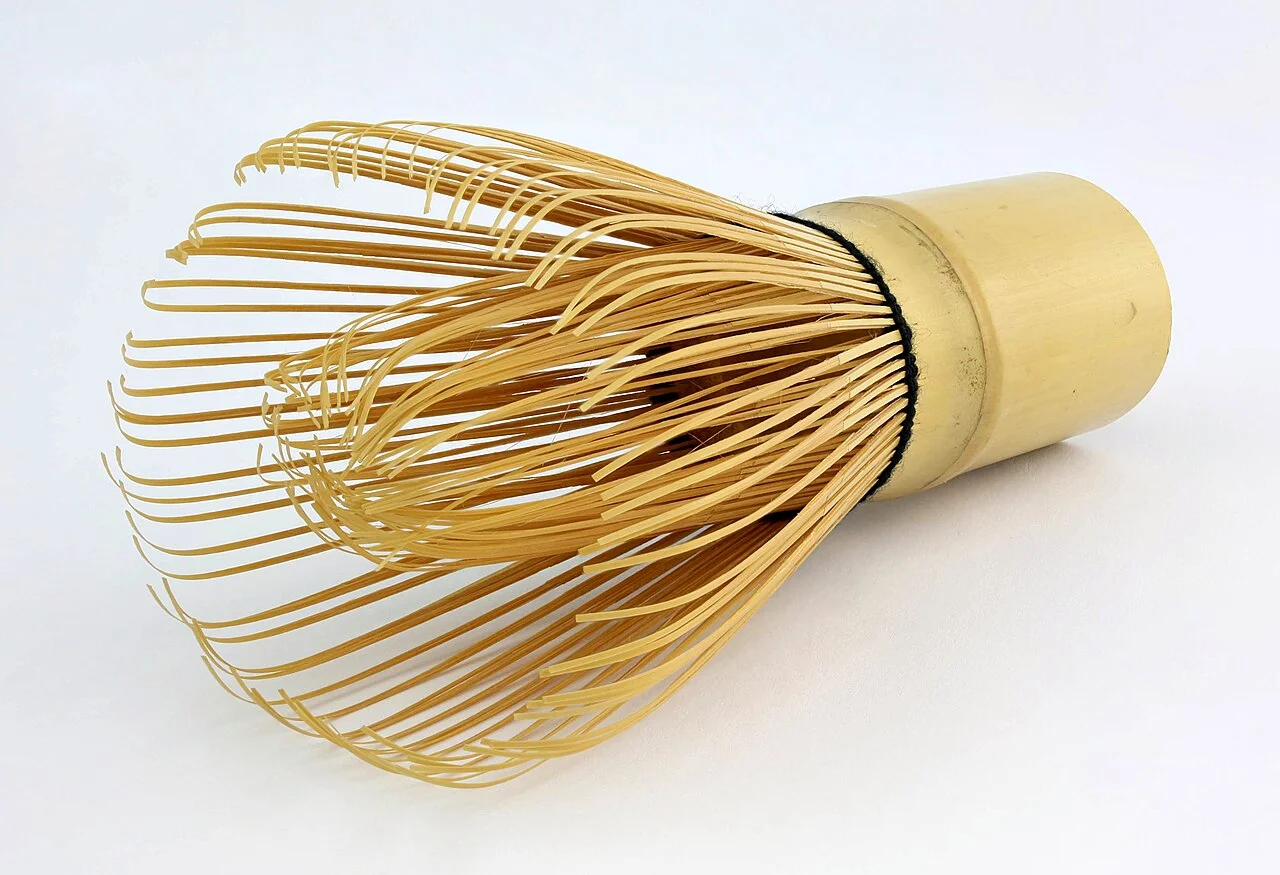
Material Annotation · Hand-Shaved Curled Bamboo Tines
Paper-thin curled tips protect soft earthenware bowls from scratching while maximizing aeration.
Muromachi Period (15th–16th century kettle) & Takayama whisk craft
Bamboo Tea Whisk (Chasen) & Muromachi Iron Kettle (Kama)
Split from a single piece of seasoned bamboo into dozens of curling tines, the ephemeral chasen meets the heavy cast-iron kama kettle—pairing weightless plant fiber with the 'wind-in-the-pines' hum of simmering water.
- Origin
- Ashiya/Tenmyō ironwork & Takayama bamboo craft, Japan
- Material
- Sand-cast iron kettle (kama); single-node split bamboo whisk (chasen)
- Dimensions
- Crane-and-pine cast-iron kettle (CMA #149865) & multi-tine bamboo whisk
- Collection
- Cleveland Museum of Art Open Access (CC0) / Wikimedia Commons (CC BY-SA 4.0)
Craft & Materiality
Master whisk makers split one bamboo section into 80–120 hair-thin outer tines curled by hand and tied with silk thread. Conversely, Muromachi iron kama kettles were cast with textured inner bottoms and crisp crane/pine reliefs to break boiling bubbles into a soothing hiss.
Usage Context
Before serving, guests listen to the kettle's simmering water ('wind through pines'). When whisking, rapid wrist strokes drive the springy bamboo tines back and forth to aerate suspended tea particles into velvety micro-foam.
Aesthetics & Patina
An iron kettle endures for centuries, accumulating mineral patina, while a delicate bamboo whisk slowly wears out and is replaced—a deliberate tension between permanence and humble perishable craft.
Verified References & Provenance
- [01] 2026Source
The Cleveland Museum of Art Open Access Collection (CC0)
Cleveland Museum of Art
Provides CC0 Public Domain metadata and imagery for Song Jian ware, Yue ware ewers, and Muromachi iron kama kettles.
- [02] 2024Source
Urasenke Official Introduction to Chado (The Way of Tea)
Urasenke Foundation
Authoritative overview of Chado lineage from Sen no Rikyū, the four principles Wa-Kei-Sei-Jaku, and modern tea gathering choreography.
- [03] 2023Source
The Metropolitan Museum of Art: The Japanese Tea Ceremony
The Metropolitan Museum of Art
Heilbrunn Timeline essay examining the transition from prized Chinese karamono utensils to wabi-cha Raku wares and bamboo scoops.