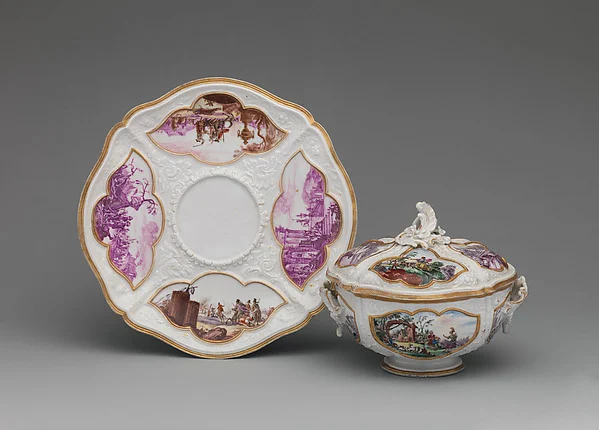
Material Annotation · Recessed Lid & Straining Gap
The raised finial insulates fingertips while tilting the lid creates a precise slit to strain tea leaves.
Qing Dynasty (18th–19th century) and living tradition
Ming–Qing Porcelain Gaiwan (Lidded Bowl)
Following the Ming transition from whipped tea cakes to steeped whole leaves, the porcelain gaiwan evolved into a complete three-piece brewing instrument—lid (heaven), saucer (earth), and bowl (humanity).
- Origin
- Jingdezhen kilns and broader Chinese porcelain tradition
- Material
- Vitrified white kaolin porcelain with clear or decorated glaze
- Dimensions
- Three-part lidded bowl, flared body, and saucer (Met #234103)
- Collection
- The Metropolitan Museum of Art Open Access (CC0) & Studio Study
Craft & Materiality
Non-porous vitrified porcelain is chemically inert, absorbing zero aroma between diverse teas. Precision fitting between the flared rim and recessed lid creates a narrow pouring gap that strains whole leaves cleanly.
Usage Context
Used equally as a direct drinking cup in Sichuan teahouses—scraping floating leaves back with the lid—and as the indispensable gongfu pouring vessel allowing five-second flash infusions.
Aesthetics & Patina
A plain white gaiwan's neutrality is its genius: it neither colors nor rounds off a tea's edges, serving as an honest optical and aromatic mirror for every tea family.
Verified References & Provenance
- [01] 2026Source
The Metropolitan Museum of Art Open Access Collection (CC0)
The Metropolitan Museum of Art
Provides CC0 Public Domain imagery and provenance data for Jian ware, Yue ware, Yixing stoneware, Raku chawan, and Georgian silver teapots.
- [02] 2022Source
Traditional tea processing techniques and associated social practices in China
UNESCO Intangible Cultural Heritage · Nomination File No. 01884
Inscribed in 2022; documents the six core Chinese tea categories, reprocessed teas, and their embedded social rituals across 44 national heritage items.