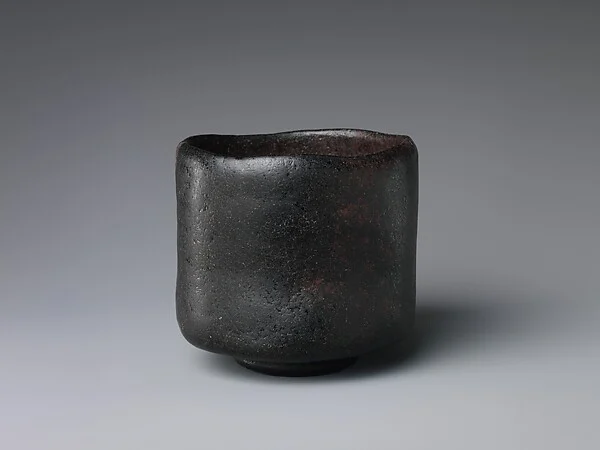
Material Annotation · Hand-Pinched Organic Contours
Rejection of the potter's wheel leaves subtle finger depressions and bamboo-carved facets across the wall.
Momoyama to Edo Period (16th–18th century)
Japanese Black Raku Tea Bowl (Kuro Raku Chawan)
Developed in late 16th-century Kyoto by potter Chōjirō under Sen no Rikyū's aesthetic direction, hand-formed Black Raku marked the decisive break from symmetrical Chinese imports toward austere wabi-cha materiality.
- Origin
- Kyoto (Raku Kiln Tradition), Japan
- Material
- Hand-pinched low-fired earthenware with lustrous black lead-iron glaze
- Dimensions
- Hand-shaped cylindrical form sized for two-handed cradling (Met #62898 / #827671)
- Collection
- The Metropolitan Museum of Art Open Access (CC0)
Craft & Materiality
Pinched by hand and carved with bamboo tools rather than thrown on a wheel, each Raku bowl was pulled red-hot from a single-chamber kiln at ~1000°C. Its porous low-fired clay insulates palms from boiling heat.
Usage Context
Reserved for whisked matcha—especially winter gatherings where thick walls keep tea warm. Held in both hands, subtle asymmetries register directly against the palms and lips.
Aesthetics & Patina
Black Raku is disciplined subtraction rather than carelessness: erasing ornament and mechanical symmetry allows the emerald-green froth of whisked matcha to become the sole visual event inside the bowl.
Verified References & Provenance
- [01] 2026Source
The Metropolitan Museum of Art Open Access Collection (CC0)
The Metropolitan Museum of Art
Provides CC0 Public Domain imagery and provenance data for Jian ware, Yue ware, Yixing stoneware, Raku chawan, and Georgian silver teapots.
- [02] 2023Source
The Metropolitan Museum of Art: The Japanese Tea Ceremony
The Metropolitan Museum of Art
Heilbrunn Timeline essay examining the transition from prized Chinese karamono utensils to wabi-cha Raku wares and bamboo scoops.
- [03] 2024Source
Urasenke Official Introduction to Chado (The Way of Tea)
Urasenke Foundation
Authoritative overview of Chado lineage from Sen no Rikyū, the four principles Wa-Kei-Sei-Jaku, and modern tea gathering choreography.