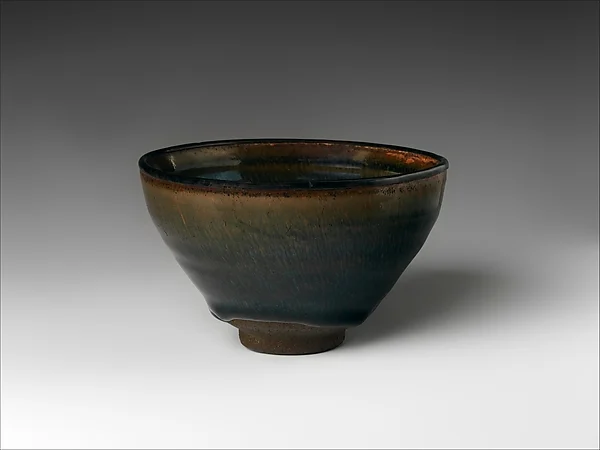
Material Annotation · Iron-Oxide 'Hare's Fur' Striations
Cooling iron-rich glaze precipitates fine russet and silvery streaks along the steep interior slope.
Southern Song Dynasty (12th–13th century)
Song Dynasty Jian Ware 'Hare's Fur' Tea Bowl
The quintessential vessel of Song whipped tea (diancha): iron-oxide streaks flow down a pitch-black glaze like fine hare's fur, creating stark visual contrast against snow-white tea foam.
- Origin
- Jian Kilns, Shuiji, Jianyang, Fujian Province
- Material
- Iron-rich dark stoneware body with thick iron-saturated glaze showing striated 'hare's fur' crystallization
- Dimensions
- Conical bowl with constricted lip and small solid foot (Met #51076 / CMA #125978)
- Collection
- The Metropolitan Museum of Art / Cleveland Museum of Art Open Access (CC0)
Craft & Materiality
High-iron clay walls are thick to retain heat during whisking. Fired above 1300°C, iron-saturated glaze flows downward and precipitates iron-oxide microcrystals upon cooling, creating unrepeatable 'hare's fur' striations and thick glaze beads above the foot.
Usage Context
Praised by Cai Xiang and Emperor Huizong, Jian bowls held finely milled tea powder whipped with a bamboo whisk (chasen). The inward-turning 'constricted lip' stabilized splashing froth during vigorous whisking and guided the liquid toward the drinker.
Aesthetics & Patina
Exported to Japan via Zen monastic networks as 'Tenmoku,' Jian ware shaped medieval East Asian connoisseurship—offering a dark mineral intensity that later Japanese tea masters would contrast against rough domestic Raku wares.
Verified References & Provenance
- [01] 2026Source
The Metropolitan Museum of Art Open Access Collection (CC0)
The Metropolitan Museum of Art
Provides CC0 Public Domain imagery and provenance data for Jian ware, Yue ware, Yixing stoneware, Raku chawan, and Georgian silver teapots.
- [02] 2026Source
The Cleveland Museum of Art Open Access Collection (CC0)
Cleveland Museum of Art
Provides CC0 Public Domain metadata and imagery for Song Jian ware, Yue ware ewers, and Muromachi iron kama kettles.
- [03] 2023Source
The Metropolitan Museum of Art: The Japanese Tea Ceremony
The Metropolitan Museum of Art
Heilbrunn Timeline essay examining the transition from prized Chinese karamono utensils to wabi-cha Raku wares and bamboo scoops.