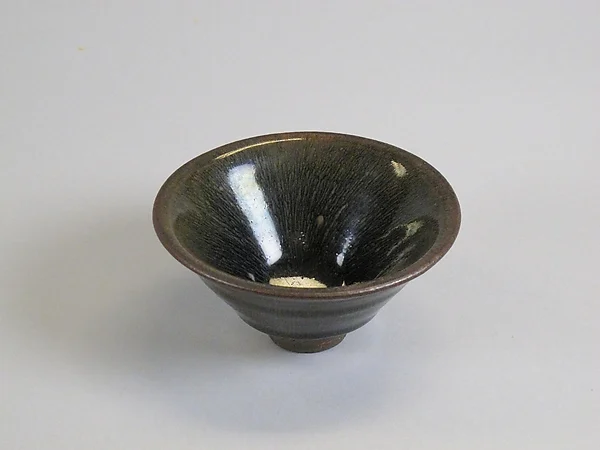
Material Annotation · Pitch-Black Contrast Surface
The dark glossy interior immediately reveals the faint wet line when tea foam begins to collapse.
Song Dynasty (11th–13th century)
Song Dynasty Jian Iron-Glazed Tea Bowl (Tea Contest Vessel)
In Song 'tea battles' (doucha), victory hinged on pure white froth and how slowly a dark 'water line' appeared where foam receded from the wall—making lustrous iron-black glaze a functional optical gauge.
- Origin
- Northern Fujian (Jian Kilns), China
- Material
- Dark stoneware body with deep iron-black glaze
- Dimensions
- Deep conical wall tapering to compact footring (Met #42457)
- Collection
- The Metropolitan Museum of Art Open Access (CC0)
Craft & Materiality
Rather than pronounced metallic streaks, this vessel showcases a dense, oil-black iron glaze. Its heavy wall acts as a thermal flywheel, sustaining the warm temperature needed to keep micro-foam intact.
Usage Context
During contests, judges inspected foam brightness and 'biting the bowl' (yaozhan): the first bowl to show a wet ring separating foam from the black rim lost the round.
Aesthetics & Patina
This bowl demonstrates how shifts in tea chemistry dictate ceramics: moving from Tang boiled infusion to Song whipped white foam inverted color taste from translucent green celadon to pitch-black stoneware.
Verified References & Provenance
- [01] 2026Source
The Metropolitan Museum of Art Open Access Collection (CC0)
The Metropolitan Museum of Art
Provides CC0 Public Domain imagery and provenance data for Jian ware, Yue ware, Yixing stoneware, Raku chawan, and Georgian silver teapots.
- [02] 2023Source
The Metropolitan Museum of Art: The Japanese Tea Ceremony
The Metropolitan Museum of Art
Heilbrunn Timeline essay examining the transition from prized Chinese karamono utensils to wabi-cha Raku wares and bamboo scoops.