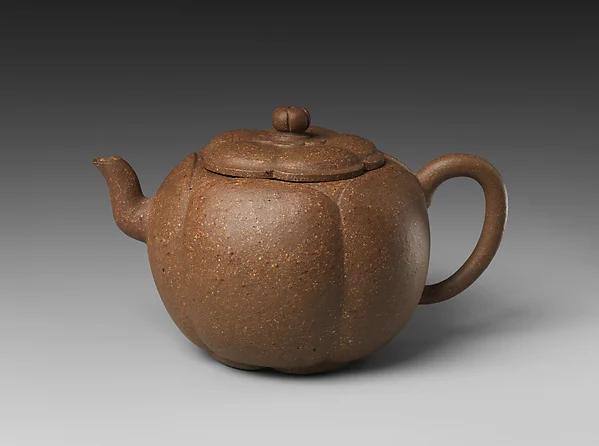
Material Annotation · Unglazed Dual-Pore Clay Body
Natural quartz grains and microscopic open/closed pores retain heat while subtly rounding tannic edges.
Qing Dynasty (17th–19th century)
Yixing Zisha Stoneware Teapot (Literati & Export Traditions)
Fired unglazed from iron-rich Yixing clays containing microscopic dual pores, zisha stoneware retained heat and softened astringency—soon becoming the structural prototype for early European metal and porcelain teapots.
- Origin
- Dingshu, Yixing, Jiangsu Province
- Material
- Unglazed Yixing zisha stoneware clay with natural double-pore microstructure
- Dimensions
- Molded plum-branch literati pot & silver-mounted export pot (Met #42323 / #200756)
- Collection
- The Metropolitan Museum of Art Open Access (CC0)
Craft & Materiality
Unlike wheel-thrown porcelain, Yixing teapots are hand-built from beaten clay slabs and joined seamlessly with carved spouts and handles. Over years of use, tea oils season the unglazed surface into a soft natural patina.
Usage Context
Celebrated by Ming literati, Yixing pots also sailed west with East India Company ships; European silversmiths frequently fitted them with silver chains and hinges (as seen in Met #200756) to protect precious lids.
Aesthetics & Patina
Yixing fused botanical relief and calligraphy with practical thermodynamics—inspiring the custom of dedicating a single porous pot to a single tea family across decades.
Verified References & Provenance
- [01] 2026Source
The Metropolitan Museum of Art Open Access Collection (CC0)
The Metropolitan Museum of Art
Provides CC0 Public Domain imagery and provenance data for Jian ware, Yue ware, Yixing stoneware, Raku chawan, and Georgian silver teapots.
- [02] 2017Source
A Thirst for Empire: How Tea Shaped the Modern World
Erika Rappaport · ISBN 9780691167114
Princeton University Press study demonstrating how temperance movements, imperial propaganda, branding, and corporate integration (such as Lipton) manufactured British imperial tea taste.