Core Research Question
Why does dried leaf from the exact same botanical species span from a few dollars per kilo to thousands—and how much of that gap measures sensory quality versus information asymmetry and social signaling?
1. Historical Context
Sky-high tea pricing predates modern marketing. From Tang imperial tribute systems to Song-dynasty Dragon-Phoenix tribute cakes, elite tea has functioned simultaneously as farm crop and status emblem. Even as Lu Yu criticized ostentation in Chajing, his regional rankings laid groundwork for hyper-specific provenance hierarchies.
From the Ming–Qing era onward, fine loose-leaf centers such as West Lake Longjing and Wuyi rock tea codified micro-gradients—pre-Qingming buds, 'true cliff' (zhengyan) crevices versus outer slopes. In the 21st century, aged Pu'er investment cycles, micro-plot naming, and livestream retail further fused agricultural goods with collectible scarcity and gifting prestige.
Meanwhile, ordinary buyers face extreme information asymmetry: without standardized origin audits or blind quality scores, consumers struggle to tell genuine single-plot spring harvests from re-blended or mislabeled stock.
2. Verified Facts & Empirical Data
CTMA's 2025 national figures establish an empirical anchor: China harvested 3.6403M tonnes of dry rough tea across 53.12M mu with primary agricultural output valued at RMB 333.19B—an average farm-gate rough-tea value near RMB 91.5/kg. Domestic traditional retail sales reached 2.3777M tonnes worth RMB 309.93B, averaging RMB 130.35/kg (roughly RMB 65 per 500g).
Internationally, 2025 bulk export averages stood at USD 3.69/kg for China, ~USD 2.20–2.27/kg for Kenya, and roughly USD 3.80–5.83/kg for Sri Lanka. The baseline physical cost of everyday tea is therefore far below luxury gift-box benchmarks.
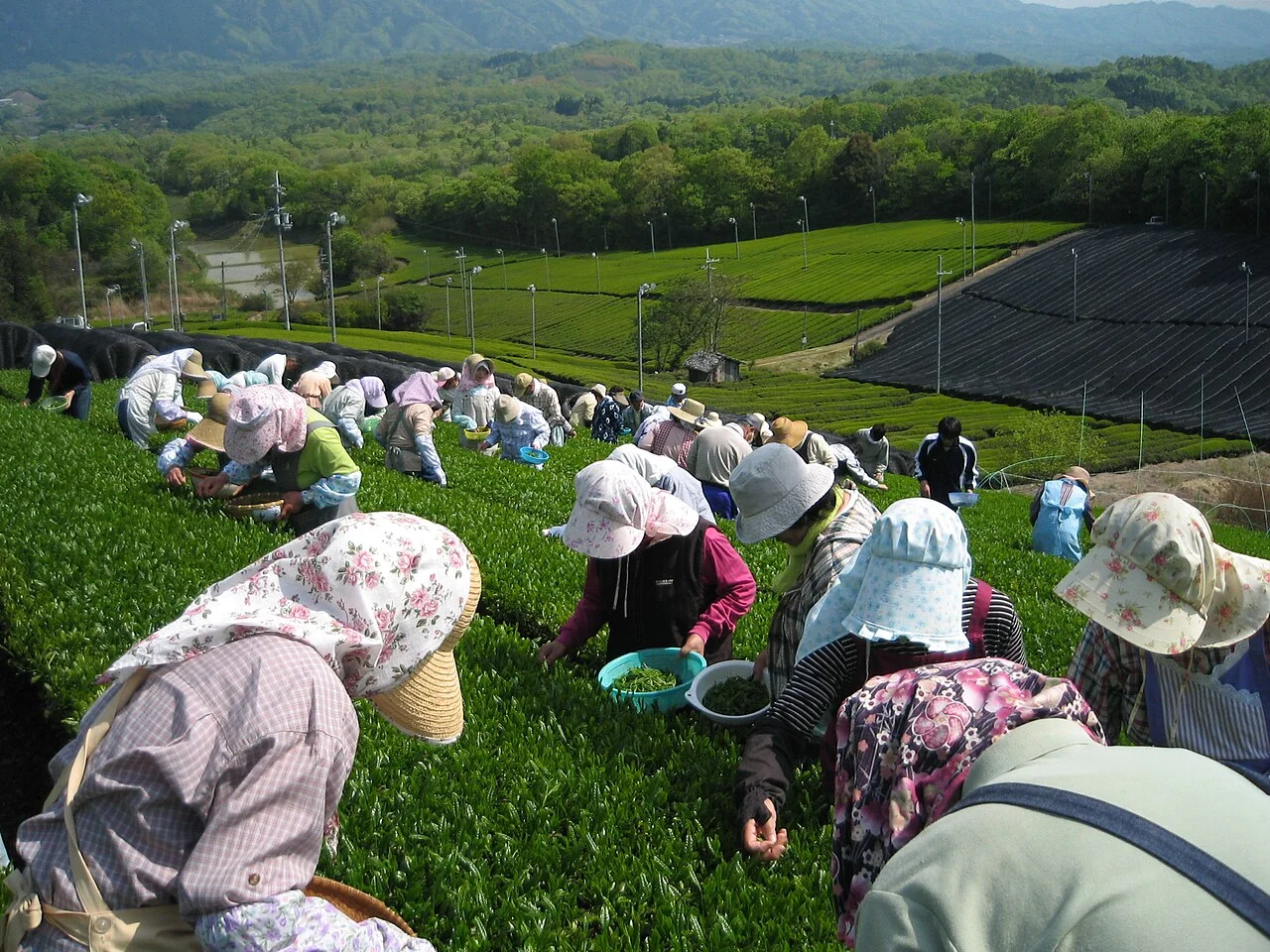
Yet FAO (2025) notes that over 60% of global tea is grown by smallholders, often on steep slopes. Fine bud-and-leaf spring picking remains fiercely labor-intensive: hand-plucking fresh buds takes hours per kilogram, and withering, pan-firing, or charcoal roasting yields roughly a 4:1 to 5:1 fresh-to-dry ratio—creating real, non-trivial cost floors for genuinely hand-crafted spring teas.
Verified Quantitative Observatory
Export Structure, Matcha Surge & Value-Chain Distribution
2025 China Tea Production Mix & Market Segments
2025 · % (Total dry rough tea: 3.6403M tonnes)55.69% of traditional domestic sales (1.324M t)
393.8k t domestic sales
317.2k t domestic sales
246.4k t domestic sales
72.8k t domestic sales
23.5k t domestic sales
3. Multi-Stakeholder Perspectives
Mountain Smallholders & Pluckers
Rising spring picking wages and fertilizer costs squeeze growers who lack direct consumer access and must sell rough leaf at local broker prices regardless of downstream gift markups.
Artisan Roasters & Tea Tasters
True scarcity lies in sensory mastery—charcoal roasting, precise oxidation, and clean finish—which determines infusion stamina and aging potential, yet is easily conflated with packaging hype.
Tea Brands & Gift Retailers
Retail markups cover rent, tasting hospitality, inventory financing, lab testing, and reputational warranty—effectively charging for curation and authenticity assurance.
Everyday Drinkers & Gift Buyers
Daily drinkers want honest flavor per yuan but lack trustworthy grading; gift buyers pay for recognizable price signals when neither giver nor recipient can verify origin.
4. Dialectical Clash: Pro vs. Strongest Rebuttal
Supporting Argument
Thesis: High-Tier Pricing Reflects Genuine Ecological Scarcity and Labor Intensity
- Physical scarcity of micro-terroir: prime cliff crevices, high-mist ridges, and low-density old trees occupy tiny acreage with narrow spring harvest windows.
- Exponential cost of sensory refinement: moving from 'clean and pleasant' to multi-layered aroma, silky broth, and ten-steep endurance requires strict bud selection, high leaf loss, and multi-stage charcoal roasting.
- Blind-tasting differentiation is real: under controlled blind cupping, superior raw leaf and craft consistently separate themselves, driving competitive bidding among knowledgeable buyers.
Strongest Counter-Argument
Counter-Thesis: Information Asymmetry and Myth-Making Erode Consumer Trust
- Physical impossibility of volume: retail sales claiming famous 'ancient-tree' or 'core-cliff' labels frequently exceed those micro-regions' biological capacity, decoupling price from provenance.
- Unfalsifiable vocabulary: opaque jargon ('mountain qi', secret plots) blocks objective comparison, unlike coffee varietal/altitude/process transparency or regulated wine appellations.
- Financial and gifting distortion: when tea serves as speculative inventory or status currency, price tracks resale expectations and box prestige rather than cup quality.
5. Unresolved Questions & Provisional Conclusion
Unresolved Questions
- Can traditional tea build verifiable origin traceability and blind-tasting standards without flattening regional craft nuance?
- As direct-from-origin e-commerce and blind-tasting communities expand, will mid-tier inflated pricing collapse into a barbell of honest daily teas and genuinely rare micro-lots?
- How much transparent premium are everyday drinkers actually willing to pay once origin labor and ecological costs are made visible?
Evidence-Based Provisional Conclusion
There is no single 'fair price' for half a kilo of tea, yet China's RMB 130.35/kg traditional retail average is a sobering anchor: good, clean, daily-drinking tea is fundamentally accessible. The real crisis is not high prices per se, but unverifiable high prices. Only transparent origin data, honest process disclosure, and accessible tasting literacy can realign price tags with cup quality and grower labor.
Verified References & Provenance
- [01] 2026Source
2025 China Tea Production-Sales Analysis & 2026 Industry Transformation Report
China Tea Marketing Association (CTMA)
Reports 2025 dry rough tea output of 3.6403M tonnes (RMB 333.19B), traditional domestic sales of 2.3777M tonnes (RMB 309.93B, avg RMB 130.35/kg), and newly-made tea retail market exceeding RMB 300B.
- [02] 2026Source
2025 China Tea Import and Export Briefing
China Tea Marketing Association (CTMA)
Based on China Customs data: 2025 tea exports reached 418,800 tonnes (+11.93% YoY), USD 1.546 billion (+8.91%), avg price USD 3.69/kg (-2.70%); green tea accounted for 88.11% of volume.
- [03] 2025Source
FAO Beverages: Tea Markets & Trade Overview & International Tea Day Address
Food and Agriculture Organization of the United Nations (FAO)
Notes in 2025 International Tea Day materials that over 60% of global tea is produced by smallholders; FAO IGG on Tea tracks processed made-tea output and uneven farm-gate price transmission.
- [04] 2025Source
International Tea Committee (ITC) & National Tea Boards (Kenya, India, Sri Lanka) 2024–2025 Export Data
ITC / Tea Board of Kenya / Sri Lanka Tea Board / Tea Board India
Aggregates 2024–2025 national export benchmarks: Kenya ~652.8k t (~$2.20–$2.27/kg bulk CTC); Sri Lanka ~258k t (~$5.50–$5.83/kg orthodox/value-added); India ~257.9k t (~$3.40/kg).
- [05] c. 760–780Source
The Classic of Tea (Chajing) by Lu Yu
Lu Yu (c. 760–780 CE)
The earliest surviving systematic monograph on tea, organized into ten chapters covering origins, tools, processing, vessels, boiling, drinking, historical anecdotes, regions, omissions, and scroll diagrams.
- [06] 2024Source
Global Market Report: Tea Prices and Sustainability
International Institute for Sustainable Development (IISD)
Examines squeezed smallholder net margins under rising input costs, stagnant auction prices, and the reach/limits of Voluntary Sustainability Standards.
Further Reading in Gallery VII