Core Research Question
Terroir is often treated as an unchanging guarantee of tea quality—yet as warming temperatures, spring droughts, and erratic monsoon deluges intensify, how are leaf chemistry and grower livelihoods actually shifting?
1. Historical Context
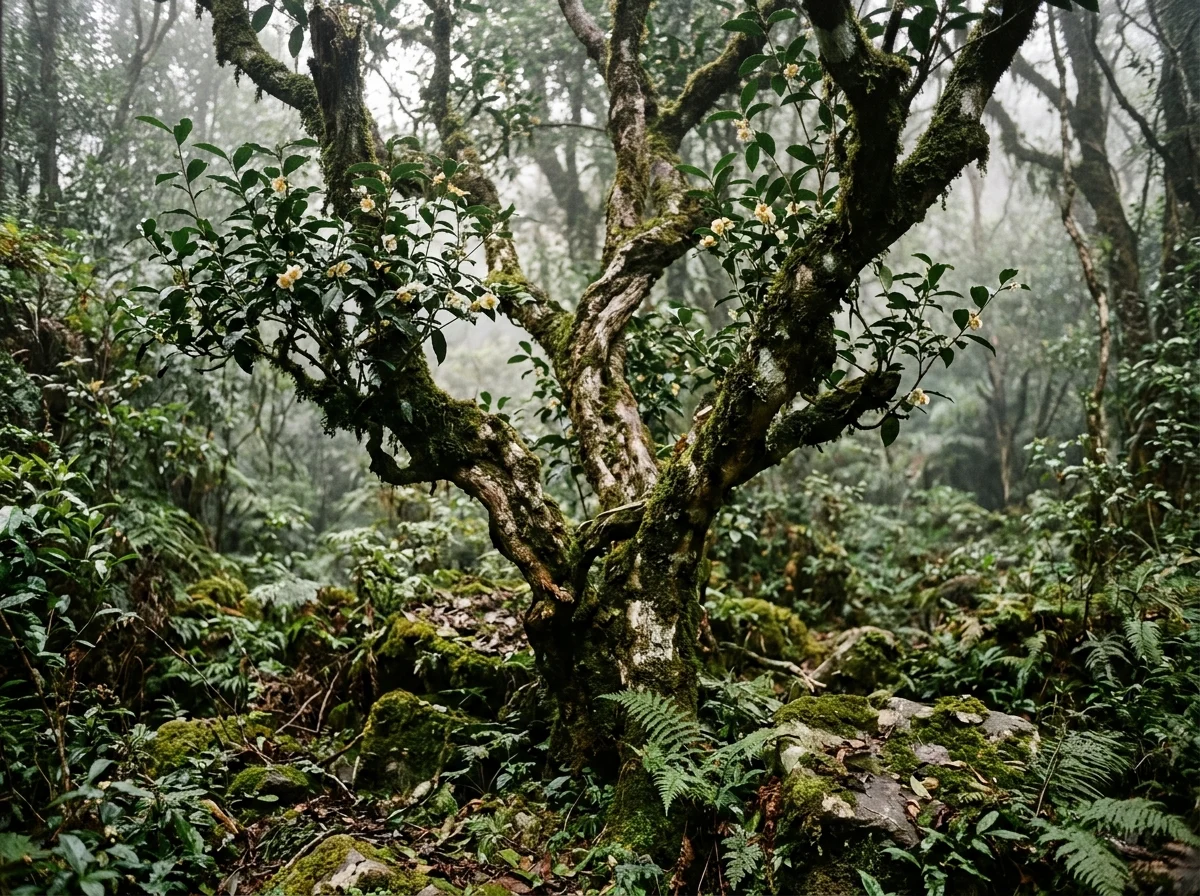
'High mountains and mist yield fine tea' is practical plant physiology disguised as poetry: cool nights, diffused light, and moderate moisture stress slow shoot elongation, allowing the bush to concentrate L-theanine (umami sweetness) alongside balanced catechins and volatile aromatics. Since Lu Yu praised weathered mountain soils in Chajing, tea growers have sought ecological equilibrium.
Yet since the 19th century, industrial expansion cleared shade forests across many regions in favor of sun-exposed monoculture terraces designed for maximum yield. Efficient under stable weather, stripped monocultures possess little resilience when climate baselines fracture.
Over the past two decades—from Yunnan and eastern China's erratic spring frosts to Assam's heatwaves and Kenya's drought-flood swings—researchers and farmers alike have watched classic harvest calendars warp, squeezing picking windows and unsettling centuries-old processing intuition.
2. Verified Facts & Empirical Data
A landmark 2014 PLOS ONE field and controlled study in Yunnan by Selena Ahmed, Colin M. Orians, J. Richard Stepp, and colleagues (DOI: 10.1371/journal.pone.0109126) quantified the chemical toll of climate extremes: when tea bushes shift abruptly from spring drought into intense monsoon rainfall, shoot growth accelerates by ~50%, triggering a severe dilution effect that cuts concentrations of key secondary metabolites—catechins and methylxanthines (including caffeine)—by up to ~50%.
The lab assays directly validated indigenous farmer knowledge: rapid rain-fed growth leaves the liquor thin and flat, depressing farm-gate leaf prices at the exact moment pest pressures and weather unpredictability intensify.
Within the broader global economy (FAO 2025; IISD 2024), because >60% of tea is grown by smallholders, most lack credit or crop insurance to absorb erratic harvests or transition to resilient agroforestry. Squeezed by tight commodity prices (such as Kenya's ~USD 2.20–2.27/kg or China's USD 3.69/kg bulk export average), cash-strapped farms can be pushed toward heavier synthetic inputs to recover tonnage—further eroding soil health and cup complexity.
Verified Quantitative Observatory
Export Structure, Matcha Surge & Value-Chain Distribution
Top Four Tea Exporters: Volume vs. Unit Realization (2024–2025)
2024–2025 · USD/kg vs. Volume (10k tonnes)~652.8k t (2025) · ~$2.20–$2.27/kg
~257.9k t (FY24-25) · ~$3.40/kg
418.8k t (2025) · $3.69/kg
~255–260k t · $3.80–$5.83/kg range
3. Multi-Stakeholder Perspectives
Weather-Exposed Smallholders
First to absorb climate shocks: spring drought cuts yield while sudden deluges dilute leaf quality and prices, yet replanting shade trees or resilient cultivars brings years of lost harvest.
Traditional Processors
Erratic leaf moisture and depleted metabolites complicate 'weather-reading' skills: waterlogged leaves easily stew during withering and oxidation, demanding constant process adjustment.
Buyers, Certifiers & Brands
Concerned by supply volatility and rising sourcing risk, brands increasingly champion 'regenerative' tea—yet purchasing contracts rarely finance the multi-year transition on the ground.
Flavor Seekers & Everyday Drinkers
Accustomed to expecting identical greatness from famous hills every spring, drinkers often blame makers for a thinner vintage rather than recognizing shifting ecological baselines.
4. Dialectical Clash: Pro vs. Strongest Rebuttal
Supporting Argument
Thesis: Climate Disruption Is Rewriting Terroir, Making Agroforestry Urgent
- Measurable chemical loss: Ahmed et al. demonstrate up to ~50% dilution of key functional and flavor compounds under drought-monsoon whipsaws.
- Monoculture vulnerability: unshaded industrial terraces suffer sharper heat stress, topsoil erosion, and pest spikes than diverse forest-tea systems.
- Feedback trap: weather-induced quality drops lower farm prices, pushing cash-tight growers toward short-term yield inputs that further degrade soil resilience.
Strongest Counter-Argument
Counter-Thesis: Cultivars, Craft Adaptation, and Ecological Markets Offer Real Buffers
- Botanical and craft adaptability: Camellia sinensis spans tropical highlands to temperate hills; drought-tolerant cultivars, drip micro-irrigation, and adjusted withering/roasting can offset moderate shifts.
- Market rewards for agroforestry: shade-grown forest systems—from Yunnan's ancient tea forests to organic biodiversity estates—already command strong premiums over bare terraces.
- Embracing vintage honesty: accepting natural year-to-year variation, as fine wine does, reduces pressure on growers to force uniform yields out of stressed landscapes.
5. Unresolved Questions & Provisional Conclusion
Unresolved Questions
- If warming forces historic cultivars upslope or poleward, how must geographically fixed origin labels adapt?
- Biodiverse shade-grown farms typically yield less per hectare—who bridges the three-to-five-year income dip while terraces transition?
- Are tea drinkers ready to accept honest vintage variation and pay reliably for ecologically resilient farming in difficult weather years?
Evidence-Based Provisional Conclusion
Tea flavor was never a static geological specimen; it is an annual record co-authored by monsoon timing, canopy shade, soil microbes, and farmer livelihoods. As shifting climates alter the very catechins and amino acids inside the leaf, safeguarding great tea becomes inseparable from protecting mountain biodiversity—and building pricing systems that reward growers for ecological stewardship rather than punishing them for lower tonnage.
Verified References & Provenance
- [01] 2014Source
Effects of Extreme Climate Events on Tea (Camellia sinensis) Functional Quality Validate Indigenous Farmer Knowledge
Selena Ahmed, Colin M. Orians, J. Richard Stepp et al. · 10.1371/journal.pone.0109126
Demonstrates that rapid shifts from spring drought to intense monsoon rain accelerate shoot growth by ~50% while diluting catechins and methylxanthines by up to ~50%, degrading sensory quality and farmer prices.
- [02] 2025Source
FAO Beverages: Tea Markets & Trade Overview & International Tea Day Address
Food and Agriculture Organization of the United Nations (FAO)
Notes in 2025 International Tea Day materials that over 60% of global tea is produced by smallholders; FAO IGG on Tea tracks processed made-tea output and uneven farm-gate price transmission.
- [03] 2024Source
Global Market Report: Tea Prices and Sustainability
International Institute for Sustainable Development (IISD)
Examines squeezed smallholder net margins under rising input costs, stagnant auction prices, and the reach/limits of Voluntary Sustainability Standards.
- [04] 2025Source
International Tea Committee (ITC) & National Tea Boards (Kenya, India, Sri Lanka) 2024–2025 Export Data
ITC / Tea Board of Kenya / Sri Lanka Tea Board / Tea Board India
Aggregates 2024–2025 national export benchmarks: Kenya ~652.8k t (~$2.20–$2.27/kg bulk CTC); Sri Lanka ~258k t (~$5.50–$5.83/kg orthodox/value-added); India ~257.9k t (~$3.40/kg).
- [05] 2026Source
2025 China Tea Import and Export Briefing
China Tea Marketing Association (CTMA)
Based on China Customs data: 2025 tea exports reached 418,800 tonnes (+11.93% YoY), USD 1.546 billion (+8.91%), avg price USD 3.69/kg (-2.70%); green tea accounted for 88.11% of volume.
- [06] c. 760–780Source
The Classic of Tea (Chajing) by Lu Yu
Lu Yu (c. 760–780 CE)
The earliest surviving systematic monograph on tea, organized into ten chapters covering origins, tools, processing, vessels, boiling, drinking, historical anecdotes, regions, omissions, and scroll diagrams.
Further Reading in Gallery VII