Wuyi Dahongpao (Big Red Robe Rock Oolong)
武夷大红袍
Danxia Sandstone Gorges, Mount Wuyi (Jiulongke, Huiyuankeng), Fujian
98–100°C
1:15 (approx. 8 g per 120 ml)
10–15 s flash steeps for first 3 rounds, +10 s later
Porcelain gaiwan or thin-walled Yixing clay pot (8–12)
History & Provenance
Wuyi rock teas entered early maritime trade as 'Bohea.' While the six cliff-side mother bushes in Jiulongke (wrapped in a folk legend of a Ming scholar's crimson robe) have been strictly protected from plucking since 2006, authentic Dahongpao today encompasses both vegetatively propagated pure-strain cultivars (such as Qidan) and master-blended Shuixian-Rougui rock teas.
Cultivar & Raw Leaf
Mature three-to-four-leaf shoots of pure-strain Qidan or classic Wuyi cultivars (Shuixian, Rougui) rooted in mineral-rich weathered sandstone.
Processing Craft
Sun-wilted leaves undergo lengthy alternating tossing and resting to achieve deep 40%–60% oxidation, double pan-fixation and rolling, stem sorting, and staged ash-covered charcoal roasting to forge Maillard depth.
Dry Leaf Appearance
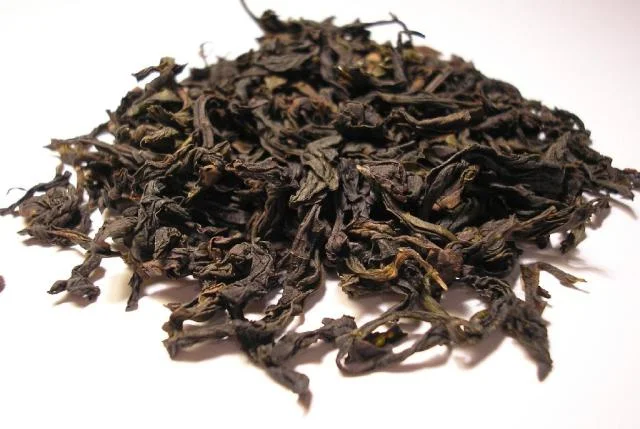
Stout, twisted strips in lustrous roasted charcoal-brown ('precious frog-skin' surface sheen).
Brewed Liquor Color
Luminous burnt orange to deep amber with a clear golden meniscus.
Aroma & Palate Profile
Layered charcoal-toast cacao, dried stone fruit, and spiced orchid over wet-stone minerality. — Structured, full-bodied, and mineral-driven—firm rock-bone grip gives way to warm, lingering sweetness.
Practical Buyer & Drinker Guide
Price Benchmarks, Authenticity Tips & Storage
Reference Price Range
Commercial Wuyi blends ~$30–$90/500g; core Zhengyan Qidan or master blends ~$180–$600+/500g
Authenticity & Buying Tips
The six ancient cliff mother bushes have been strictly protected since 2006—any 'Mother Bush Dahongpao' for sale is fake; genuine bottlings use propagated Qidan or master rock-tea blends.
Home Storage Advice
Refrigerate vacuum-packed light oolongs; store medium-to-heavy roasted oolongs airtight at room temperature.
Related Teas in This Category
Unmistakable high-note orchid perfume ('Guanyin rhyme'), deepening to caramelized stone fruit and toasted grain when roasted.
Explosively aromatic: intoxicating gardenia, ripe white peach, honeysuckle, or baked sweet-potato honey depending on the clone.
Toasted hazelnut and warm caramel sugar draped over soft orchid and poached pear.
Verified References & Provenance
- [01] 1979Source
Chen Chuan's Six-Category Tea Classification (1979) & Camellia sinensis Phylogeography
Chen Chuan (1979) / Chen Zongmao (ed., China Tea Classic)
Chen Chuan (1979) established the modern scientific taxonomy of six tea families based on processing mechanisms (enzyme inactivation, withering, yellowing, semi-oxidation, full oxidation, microbial piling) rather than linear fermentation; Chen Zongmao's China Tea Classic synthesizes modern agronomy and tea chemistry.
- [02] 2022Source
Traditional tea processing techniques and associated social practices in China
UNESCO Intangible Cultural Heritage · Nomination File No. 01884
Inscribed in 2022; documents the six core Chinese tea categories, reprocessed teas, and their embedded social rituals across 44 national heritage items.
- [03] 2020Source
Tea War: A History of Capitalism in China and India
Andrew B. Liu · 10.12987/yale/9780300243734.001.0001
Yale University Press comparative history of Huizhou, Wuyi, and Assam, showing how both colonial penal indenture and Chinese piece-rate time discipline constituted dynamic Asian capitalist accumulation.