Anji Baicha (Anji 'White' Tea)
安吉白茶
Anji County, Huzhou (Xilong, Tianhuangping), Zhejiang
80–85°C
1:50 (approx. 3 g per 150 ml)
45–60 s
Tall glass tumbler or porcelain gaiwan (3–4)
History & Provenance
In the early 1980s, researchers propagated a wild temperature-sensitive albino tea bush discovered in Anji's mountains as the cultivar 'Baiye No. 1.' Although marketed with an allusion to Song-era white-leaf rarities, it was deliberately crafted using modern green-tea fixation.
Cultivar & Raw Leaf
Plucked exclusively during its spring albino phase from 'Baiye No. 1' shoots, yielding depressed chlorophyll and catechin levels alongside remarkably elevated L-theanine.
Processing Craft
Standard baked green-tea processing: brief spreading, high-heat drum or hot-air fixation to denature PPO, gentle strip-shaping, and staged drying—completely distinct from white tea's extended withering.
Dry Leaf Appearance
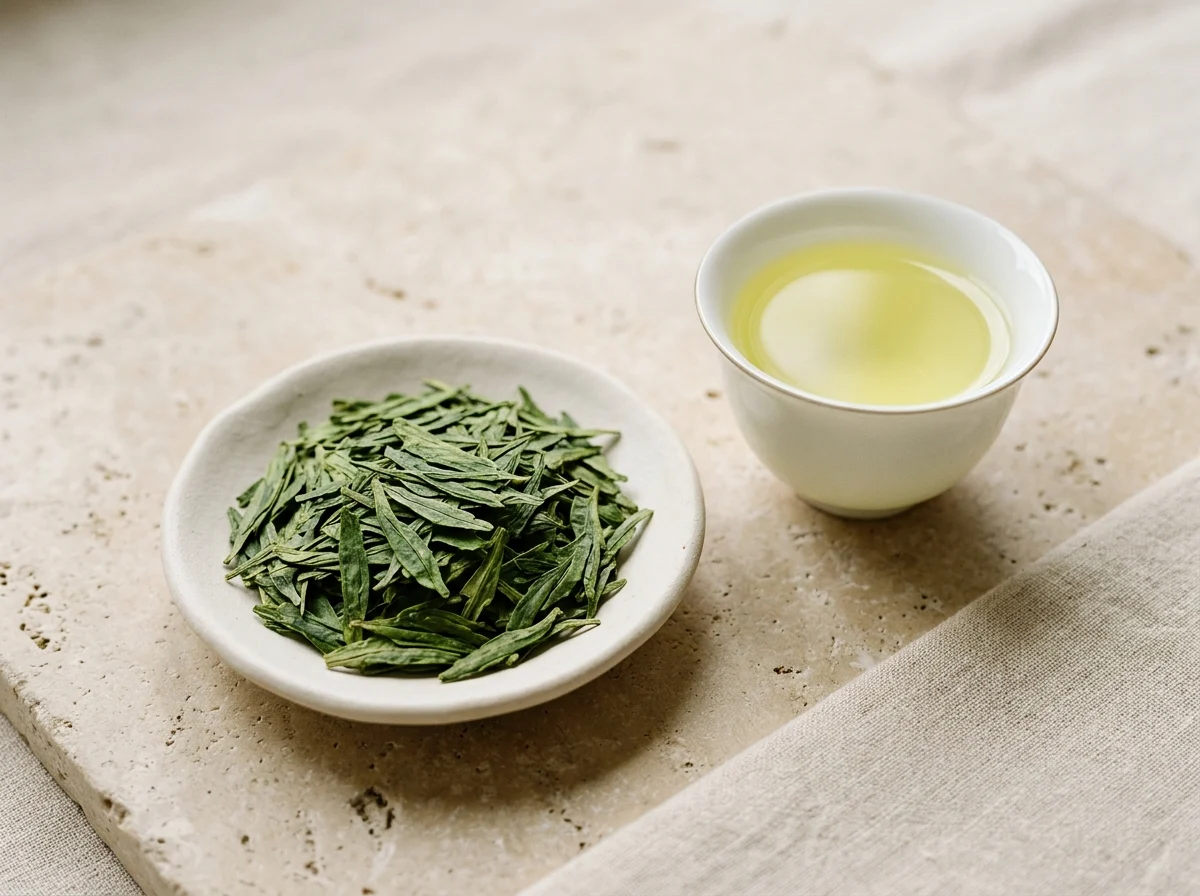
Slender phoenix-feather blades with pale jade veins contrasting against creamy ivory-white leaf lamina.
Brewed Liquor Color
Limpid pale straw to delicate champagne-jade.
Aroma & Palate Profile
Delicate bamboo leaf, sweet snow-pea shoot, and soft orchid notes with a gentle broth-like freshness. — Silky, profoundly savory-sweet broth with an almost complete absence of bitterness or astringency.
Practical Buyer & Drinker Guide
Price Benchmarks, Authenticity Tips & Storage
Reference Price Range
Everyday spring lots ~$35–$90/500g; core Xilong pre-Qingming Baiye No. 1 ~$120–$280/500g
Authenticity & Buying Tips
Never age Anji Baicha like Fuding White Tea—it is a green tea whose prized savory L-theanine freshness fades after a single year.
Home Storage Advice
Requires airtight, light-proof refrigeration or freezer storage.
Related Teas in This Category
Clean toasted chestnut and warm bean aroma lifted by subtle spring orchid clarity in high-elevation lots.
Expressive orchard blossom and stone-fruit fragrance lifted by sweet downy pekoe notes.
Lifted wild mountain orchid fragrance backed by delicate downy sweetness.
Verified References & Provenance
- [01] 1979Source
Chen Chuan's Six-Category Tea Classification (1979) & Camellia sinensis Phylogeography
Chen Chuan (1979) / Chen Zongmao (ed., China Tea Classic)
Chen Chuan (1979) established the modern scientific taxonomy of six tea families based on processing mechanisms (enzyme inactivation, withering, yellowing, semi-oxidation, full oxidation, microbial piling) rather than linear fermentation; Chen Zongmao's China Tea Classic synthesizes modern agronomy and tea chemistry.
- [02] 2022Source
Traditional tea processing techniques and associated social practices in China
UNESCO Intangible Cultural Heritage · Nomination File No. 01884
Inscribed in 2022; documents the six core Chinese tea categories, reprocessed teas, and their embedded social rituals across 44 national heritage items.