West Lake Longjing (Dragon Well)
西湖龙井
West Lake Hills, Hangzhou (Shifeng, Longjing, Yunqi, Hupao, Meijiawu)
80–85°C
1:50 (approx. 3 g per 150 ml)
45–60 s first steep, +15 s thereafter
Tall clear glass or thin porcelain gaiwan (3–4)
History & Provenance
Tea cultivation around Hangzhou's Tianzhu and Lingyin temples was already noted in Lu Yu's eighth-century Classic of Tea. After Qing Emperor Qianlong visited the Dragon Well hills in the eighteenth century and praised local harvests, pan-pressed flat Longjing crystallized as China's emblematic green tea.
Cultivar & Raw Leaf
Spring buds and newly unfurled one-bud-one-leaf shoots plucked from small-leaf cultivars such as the traditional Longjing landrace and Longjing 43 around Qingming.
Processing Craft
Fresh shoots rest briefly indoors to shed surface moisture, then undergo two-stage manual pan-firing in a seasoned wok (initial shaping and final polishing) using pressing and smoothing motions that arrest polyphenol oxidase and flatten the leaf.
Dry Leaf Appearance
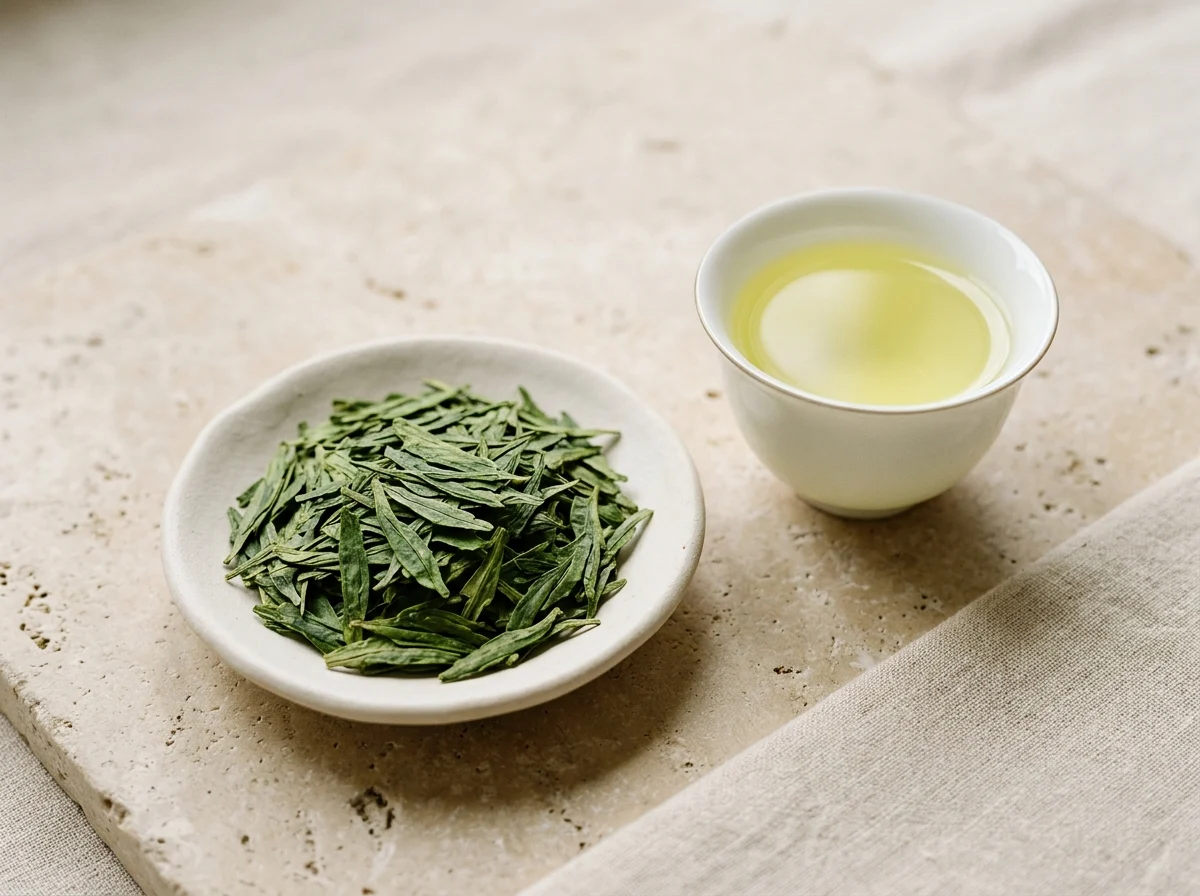
Flat, smooth, sword-like blades resembling upright bowls' nails in muted chartreuse to jade-gold, free of loose surface fuzz.
Brewed Liquor Color
Clear pale jade tinged with bright apricot-yellow.
Aroma & Palate Profile
Clean toasted chestnut and warm bean aroma lifted by subtle spring orchid clarity in high-elevation lots. — Brisk yet rounded on the palate, pairing savory-sweet broth with crisp clarity and a lingering, clean finish.
Practical Buyer & Drinker Guide
Price Benchmarks, Authenticity Tips & Storage
Reference Price Range
Regional Zhejiang Longjing ~$30–$75/500g; authentic pre-Qingming West Lake core lots ~$220–$700+/500g
Authenticity & Buying Tips
Authentic West Lake Longjing shows muted olive-chartreuse ('brown-rice yellow-green') rather than neon green; ultra-cheap 'Shifeng Pre-Qingming' bargains are almost always out-of-region imitations.
Home Storage Advice
Seal airtight in opaque foil/tin and refrigerate at 0–5°C away from food odors.
Related Teas in This Category
Expressive orchard blossom and stone-fruit fragrance lifted by sweet downy pekoe notes.
Lifted wild mountain orchid fragrance backed by delicate downy sweetness.
Pronounced sweet chestnut aroma layered with crisp spring verdure and pekoe.
Verified References & Provenance
- [01] 1979Source
Chen Chuan's Six-Category Tea Classification (1979) & Camellia sinensis Phylogeography
Chen Chuan (1979) / Chen Zongmao (ed., China Tea Classic)
Chen Chuan (1979) established the modern scientific taxonomy of six tea families based on processing mechanisms (enzyme inactivation, withering, yellowing, semi-oxidation, full oxidation, microbial piling) rather than linear fermentation; Chen Zongmao's China Tea Classic synthesizes modern agronomy and tea chemistry.
- [02] 2022Source
Traditional tea processing techniques and associated social practices in China
UNESCO Intangible Cultural Heritage · Nomination File No. 01884
Inscribed in 2022; documents the six core Chinese tea categories, reprocessed teas, and their embedded social rituals across 44 national heritage items.
- [03] c. 760–780Source
The Classic of Tea (Chajing) by Lu Yu
Lu Yu (c. 760–780 CE)
The earliest surviving systematic monograph on tea, organized into ten chapters covering origins, tools, processing, vessels, boiling, drinking, historical anecdotes, regions, omissions, and scroll diagrams.