Huangshan Maofeng (Yellow Mountain Fur Peak)
黄山毛峰
Huangshan Highlands (Taohuafeng, Tangkou, Fuxi), Anhui
80–85°C
1:50 (approx. 3 g per 150 ml)
45–60 s
Glass tumbler or white porcelain gaiwan (3–4)
History & Provenance
Developed around 1875 by Huizhou tea merchant Xie Zheng'an of the Xie Yuda tea firm using high-mountain spring shoots, Huangshan Maofeng refined local baked-green methods into China's benchmark hongqing (hot-air baked) green tea.
Cultivar & Raw Leaf
Plump mountain-grown Huangshan landrace shoots (one bud with one or two nascent leaves) retaining the characteristic golden-tinged basal scale leaf.
Processing Craft
Lightly pan-fixed and gently shaped without heavy rolling, then dried in staged low-to-moderate baking cycles to preserve airy orchid aromatics.
Dry Leaf Appearance
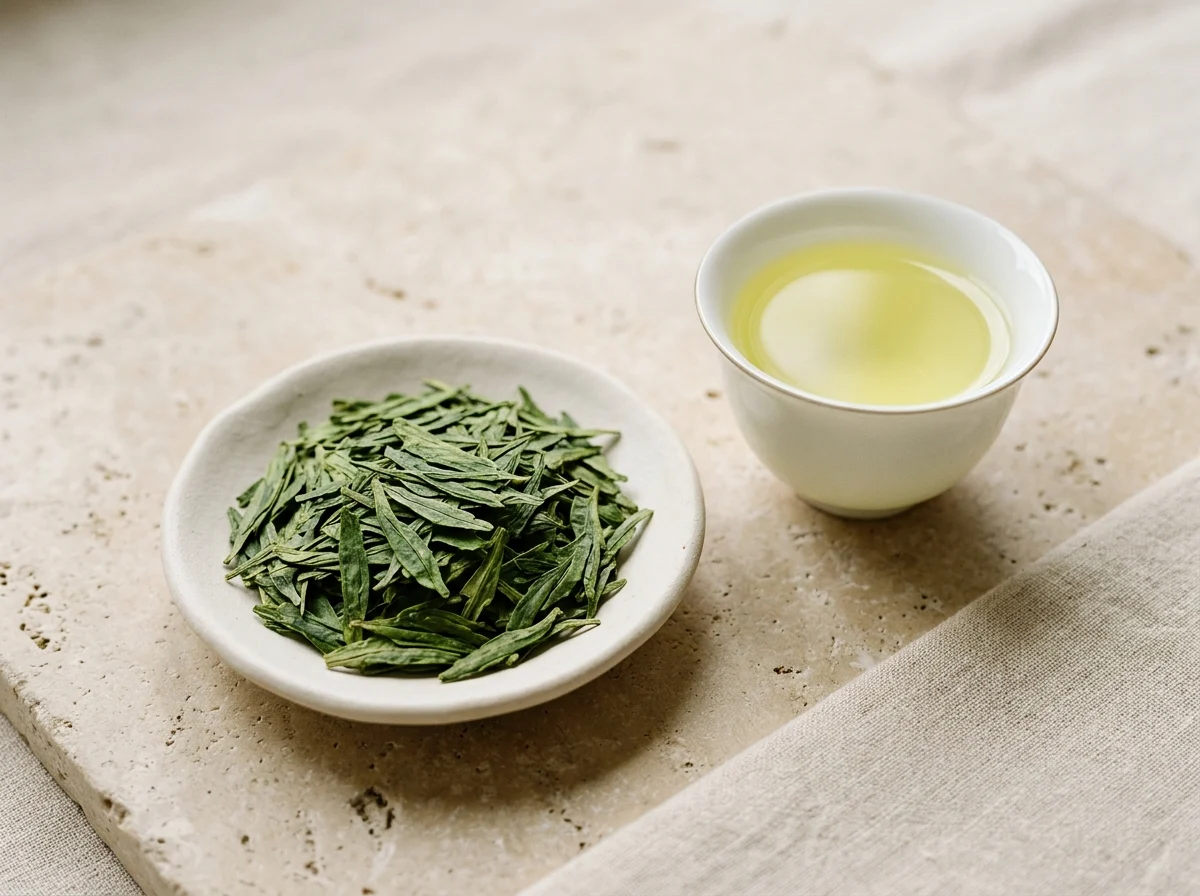
Slightly curved sparrow-tongue shoots tipped with silver down, ivory-jade hue, and warm golden basal leaflets.
Brewed Liquor Color
Crystal-clear pale celadon with a faint straw sheen.
Aroma & Palate Profile
Lifted wild mountain orchid fragrance backed by delicate downy sweetness. — Clean, buoyant, and gently sweet with minimal astringency and a lingering floral aftertaste.
Practical Buyer & Drinker Guide
Price Benchmarks, Authenticity Tips & Storage
Reference Price Range
Everyday spring green tea ~$22–$65/500g; core GI pre-Qingming lots ~$90–$380+/500g
Authenticity & Buying Tips
Freshness matters most: current-year spring lots offer far better value than stale 'rare' tins; seek clean nutty or floral lift without scorched bitterness.
Home Storage Advice
Light, moisture, and heat ruin green tea—seal in opaque foil and refrigerate; let chilled tins warm to room temp before opening.
Related Teas in This Category
Clean toasted chestnut and warm bean aroma lifted by subtle spring orchid clarity in high-elevation lots.
Expressive orchard blossom and stone-fruit fragrance lifted by sweet downy pekoe notes.
Pronounced sweet chestnut aroma layered with crisp spring verdure and pekoe.
Verified References & Provenance
- [01] 1979Source
Chen Chuan's Six-Category Tea Classification (1979) & Camellia sinensis Phylogeography
Chen Chuan (1979) / Chen Zongmao (ed., China Tea Classic)
Chen Chuan (1979) established the modern scientific taxonomy of six tea families based on processing mechanisms (enzyme inactivation, withering, yellowing, semi-oxidation, full oxidation, microbial piling) rather than linear fermentation; Chen Zongmao's China Tea Classic synthesizes modern agronomy and tea chemistry.
- [02] 2022Source
Traditional tea processing techniques and associated social practices in China
UNESCO Intangible Cultural Heritage · Nomination File No. 01884
Inscribed in 2022; documents the six core Chinese tea categories, reprocessed teas, and their embedded social rituals across 44 national heritage items.
- [03] 2020Source
Tea War: A History of Capitalism in China and India
Andrew B. Liu · 10.12987/yale/9780300243734.001.0001
Yale University Press comparative history of Huizhou, Wuyi, and Assam, showing how both colonial penal indenture and Chinese piece-rate time discipline constituted dynamic Asian capitalist accumulation.