Huoshan Huangya (Huoshan Yellow Buds)
霍山黄芽
Huoshan, Dabie Mountains, Anhui
85°C
1:45 (approx. 3.5 g per 150 ml)
45–60 s
White porcelain gaiwan or glass cup (4–5)
History & Provenance
Mentioned in Li Zhao's Tang Guoshibu ('Shouzhou produces the yellow buds of Huoshan') alongside Lu Yu's notice of Shouzhou tea and later Ming gazetteers, traditional yellowing declined in the twentieth century until local artisans restored authentic menhuang processing in the 1970s.
Cultivar & Raw Leaf
Early spring one-bud-one-leaf and one-bud-two-leaf shoots from high-elevation Huoshan cultivars.
Processing Craft
Pan-fixed and lightly shaped without heavy rolling, semi-dried, then heaped warm in baskets or paper for 24–48 hours of yellowing before final charcoal baking.
Dry Leaf Appearance
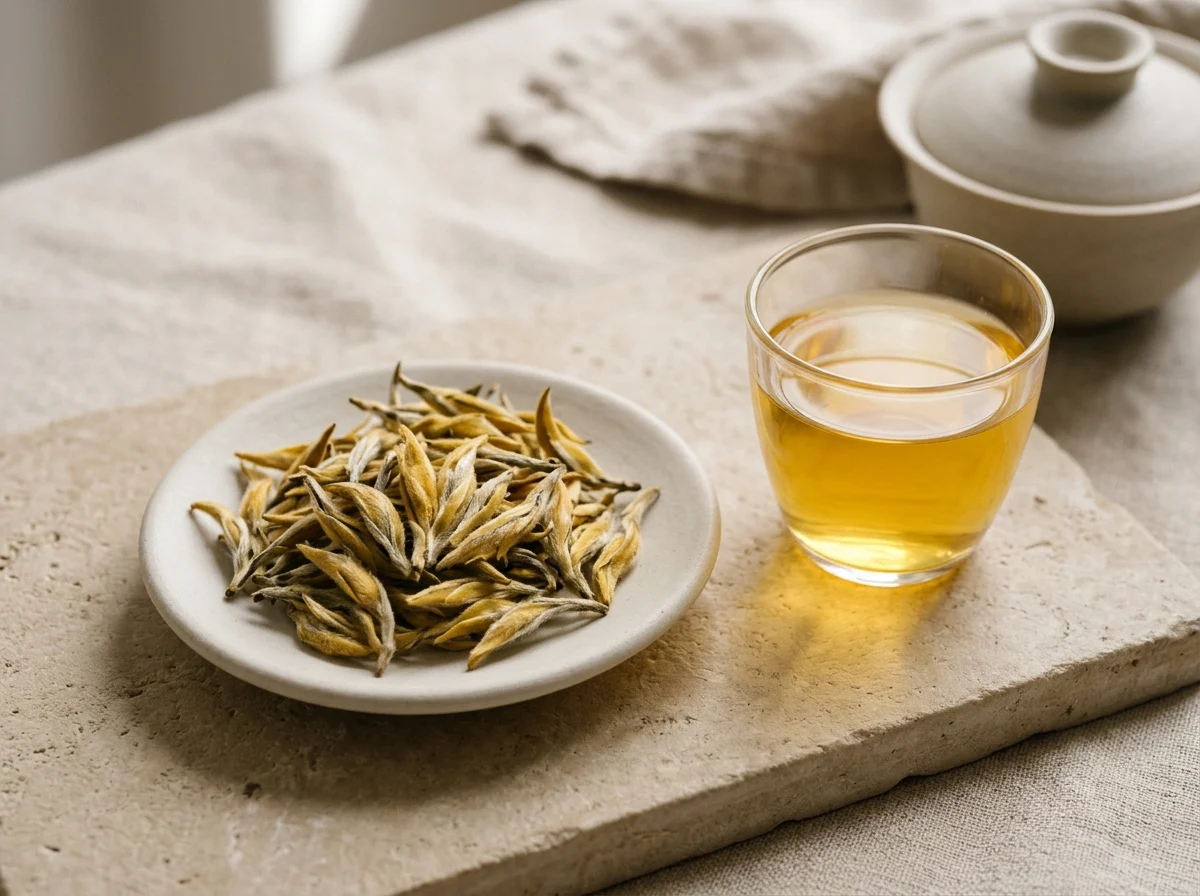
Sparrow-tongue shoots gently opened in warm olive-gold with soft silver down.
Brewed Liquor Color
Clear golden-chartreuse.
Aroma & Palate Profile
Fresh sweet bean and chestnut warmed by delicate corn silk and meadow floral notes. — Lively yet rounded—marrying mountain spring crispness with yellow tea's signature smooth finish.
Practical Buyer & Drinker Guide
Price Benchmarks, Authenticity Tips & Storage
Reference Price Range
Everyday yellow leaf teas ~$15–$45/500g; artisan yellow bud teas ~$90–$260/500g
Authenticity & Buying Tips
True menhuang yellowing creates smooth, corn-sweet amber broth gentle on the stomach—distinct from stale oxidized green tea.
Home Storage Advice
Keep sealed in dark cool tins; enjoy bud teas within 12 months, while high-fired Huangdacha holds 2+ years.
Related Teas in This Category
Gentle sweet corn, steamed cane sugar, and soft toasted cereal floral notes.
Sweet roasted chestnut mingled with steamed grain and gentle honey.
Unmistakable toasted rice-crust ('guoba'), dark caramel, and warm roasted grain.
Verified References & Provenance
- [01] c. 760–780Source
The Classic of Tea (Chajing) by Lu Yu
Lu Yu (c. 760–780 CE)
The earliest surviving systematic monograph on tea, organized into ten chapters covering origins, tools, processing, vessels, boiling, drinking, historical anecdotes, regions, omissions, and scroll diagrams.
- [02] 1979Source
Chen Chuan's Six-Category Tea Classification (1979) & Camellia sinensis Phylogeography
Chen Chuan (1979) / Chen Zongmao (ed., China Tea Classic)
Chen Chuan (1979) established the modern scientific taxonomy of six tea families based on processing mechanisms (enzyme inactivation, withering, yellowing, semi-oxidation, full oxidation, microbial piling) rather than linear fermentation; Chen Zongmao's China Tea Classic synthesizes modern agronomy and tea chemistry.
- [03] 2022Source
Traditional tea processing techniques and associated social practices in China
UNESCO Intangible Cultural Heritage · Nomination File No. 01884
Inscribed in 2022; documents the six core Chinese tea categories, reprocessed teas, and their embedded social rituals across 44 national heritage items.