Junshan Yinzhen (Junshan Silver Needle)
君山银针
Junshan Island, Lake Dongting, Yueyang, Hunan
85–90°C
1:40 (approx. 3–4 g per 150 ml)
60–90 s first steep (watch buds rise and settle)
Tall clear glass or white porcelain gaiwan (4–5)
History & Provenance
Tea from Lake Dongting's Junshan Island was praised in Tang dynasty chronicles and elevated as Qing imperial tribute. Its modern identity rests on alternating drying and paper-wrapped yellowing cycles, making it China's foremost yellow bud tea.
Cultivar & Raw Leaf
Plump spring single buds plucked from Junshan Island's sandy lake-mist soils under strict timing rules excluding rain-wet or damaged tips.
Processing Craft
Following rapid thermal fixation, buds cycle through staged drying and warm kraft-paper wrapping (menhuang) over roughly 72 hours, driving non-enzymatic chlorophyll degradation and catechin mellowing.
Dry Leaf Appearance
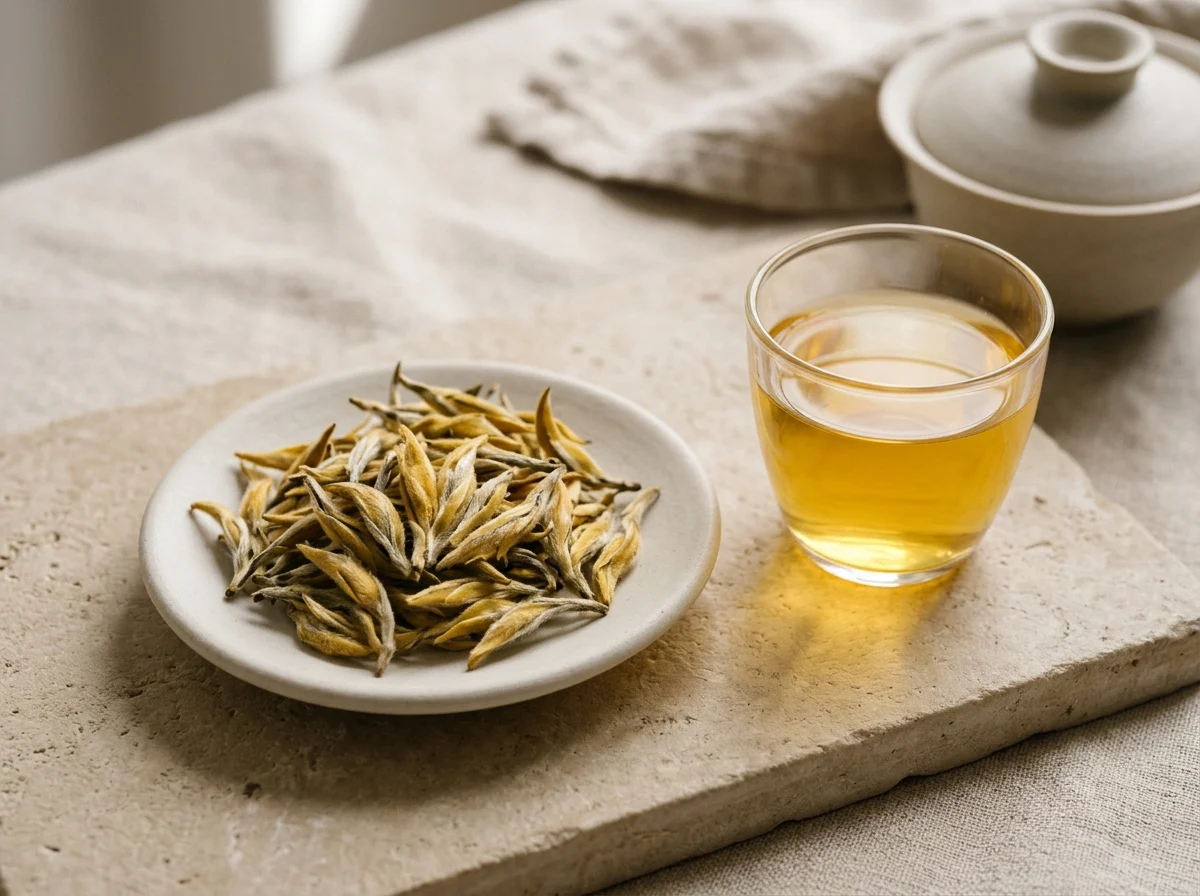
Stout, straight buds sheathed in pale golden down over rich amber-yellow cores.
Brewed Liquor Color
Luminous apricot-amber, clear and radiant.
Aroma & Palate Profile
Gentle sweet corn, steamed cane sugar, and soft toasted cereal floral notes. — Remarkably gentle and broth-like—all raw grassy astringency mellows into silky rice-water sweetness.
Practical Buyer & Drinker Guide
Price Benchmarks, Authenticity Tips & Storage
Reference Price Range
Everyday yellow leaf teas ~$15–$45/500g; artisan yellow bud teas ~$90–$260/500g
Authenticity & Buying Tips
True menhuang yellowing creates smooth, corn-sweet amber broth gentle on the stomach—distinct from stale oxidized green tea.
Home Storage Advice
Keep sealed in dark cool tins; enjoy bud teas within 12 months, while high-fired Huangdacha holds 2+ years.
Related Teas in This Category
Sweet roasted chestnut mingled with steamed grain and gentle honey.
Fresh sweet bean and chestnut warmed by delicate corn silk and meadow floral notes.
Unmistakable toasted rice-crust ('guoba'), dark caramel, and warm roasted grain.
Verified References & Provenance
- [01] 1979Source
Chen Chuan's Six-Category Tea Classification (1979) & Camellia sinensis Phylogeography
Chen Chuan (1979) / Chen Zongmao (ed., China Tea Classic)
Chen Chuan (1979) established the modern scientific taxonomy of six tea families based on processing mechanisms (enzyme inactivation, withering, yellowing, semi-oxidation, full oxidation, microbial piling) rather than linear fermentation; Chen Zongmao's China Tea Classic synthesizes modern agronomy and tea chemistry.
- [02] 2022Source
Traditional tea processing techniques and associated social practices in China
UNESCO Intangible Cultural Heritage · Nomination File No. 01884
Inscribed in 2022; documents the six core Chinese tea categories, reprocessed teas, and their embedded social rituals across 44 national heritage items.