Keemun Black Tea (Qimen Hongcha)
祁门红茶
Qimen County (Likou, Zhukou, Pingli), southern Anhui
90–95°C
1:35 (approx. 4 g per 140–150 ml)
20–30 s gongfu; 3 min western teapot
White porcelain gaiwan or bone china teapot (5–7)
History & Provenance
Created in 1875 when Hu Yuanlong and Yu Ganchen adapted Fujian black-tea oxidation to Qimen's native Zhuye cultivar (previously processed only as green tea), Keemun surged into London blending houses by the early 1900s as the aromatic 'Queen of Black Teas.'
Cultivar & Raw Leaf
Spring one-bud-two-to-three-leaf shoots of the endemic Qimen Zhuye cultivar, unusually rich in geraniol and rose-scented terpene precursors.
Processing Craft
Classic Congou craft: controlled indoor withering, gentle rolling, warm humid oxidation, initial firing, and elaborate multi-stage sifting, winnowing, hand-sorting, and blending into refined grades.
Dry Leaf Appearance
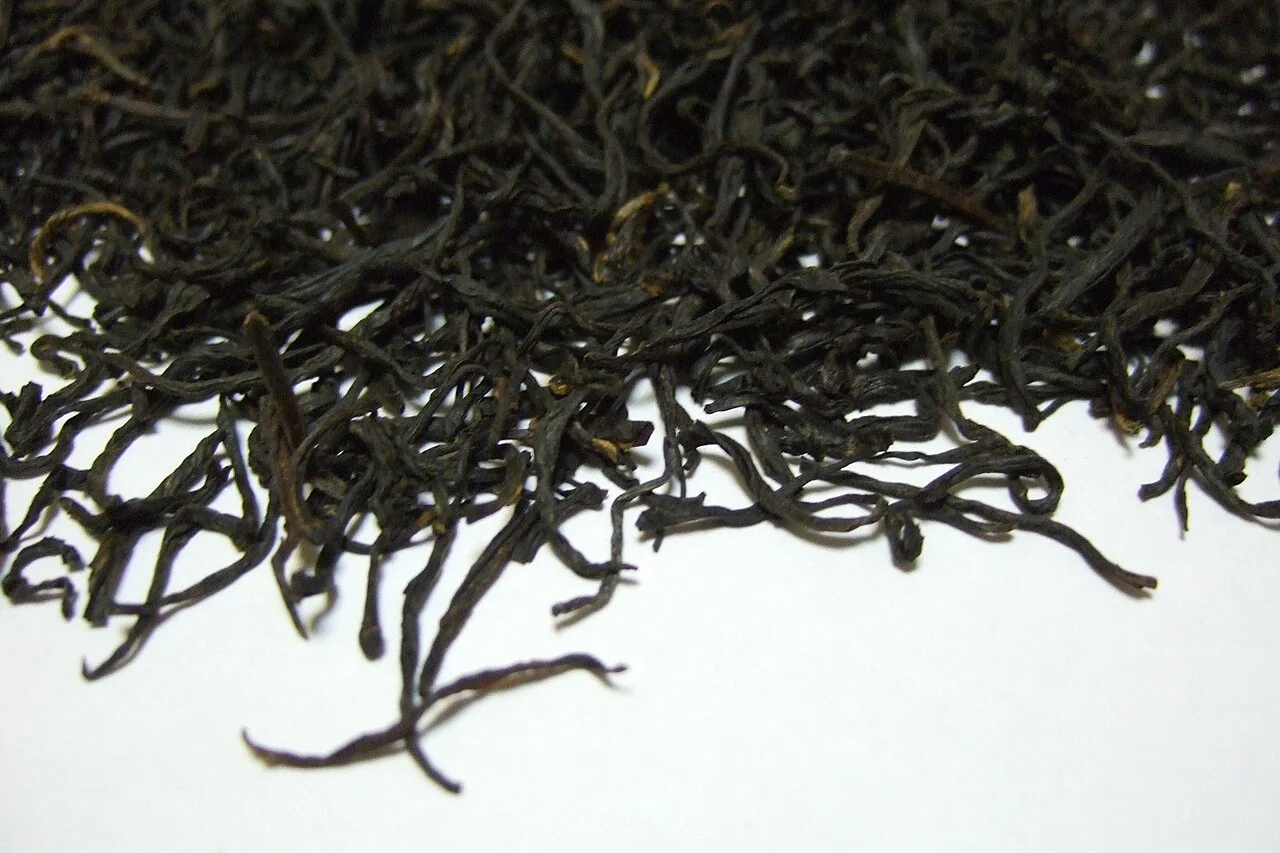
Finely cut, slender, uniform glossy black strips—traditionally graded to pinpoint uniformity.
Brewed Liquor Color
Bright ruby-crimson with crisp clarity, often showing natural brisk 'creaming' upon cooling.
Aroma & Palate Profile
The celebrated 'Keemun aroma': delicate dried rose petals, baked apple, warm honey, and subtle cedarwood. — Balanced, velvety, and gently brisk—subtle enough to drink straight for its rose-petal complexity, yet structured for classic afternoon blends.
Practical Buyer & Drinker Guide
Price Benchmarks, Authenticity Tips & Storage
Reference Price Range
Qimen Xiangluo/Maofeng ~$30–$75/500g; classic refined Keemun Congou ~$90–$240/500g
Authenticity & Buying Tips
Classic Keemun Congou is finely cut and rose-cedar aromatic; newer coiled 'Xiangluo' styles are sweeter and rounder.
Home Storage Advice
Store airtight in dark metal tins at room temperature; enjoys a 1–3 year sweet spot without refrigeration.
Related Teas in This Category
Traditional smoked: clean resinous pine smoke and dried longan; unsmoked: sweet wildflower, roasted yam, and fresh longan nectar.
Lush roasted sweet potato, warm maltose, cacao, and dried tropical fruit.
High-altitude blossom, wildflower honey, sweet potato, and nectarine unfolding cleanly in successive waves.
Verified References & Provenance
- [01] 1979Source
Chen Chuan's Six-Category Tea Classification (1979) & Camellia sinensis Phylogeography
Chen Chuan (1979) / Chen Zongmao (ed., China Tea Classic)
Chen Chuan (1979) established the modern scientific taxonomy of six tea families based on processing mechanisms (enzyme inactivation, withering, yellowing, semi-oxidation, full oxidation, microbial piling) rather than linear fermentation; Chen Zongmao's China Tea Classic synthesizes modern agronomy and tea chemistry.
- [02] 2020Source
Tea War: A History of Capitalism in China and India
Andrew B. Liu · 10.12987/yale/9780300243734.001.0001
Yale University Press comparative history of Huizhou, Wuyi, and Assam, showing how both colonial penal indenture and Chinese piece-rate time discipline constituted dynamic Asian capitalist accumulation.
- [03] 2022Source
Traditional tea processing techniques and associated social practices in China
UNESCO Intangible Cultural Heritage · Nomination File No. 01884
Inscribed in 2022; documents the six core Chinese tea categories, reprocessed teas, and their embedded social rituals across 44 national heritage items.