Taiping Houkui (Monkey Chief)
太平猴魁
Houkeng & Hougang Villages, Huangshan District, Anhui
80–85°C
1:50 (3–4 g per 180 ml tall glass)
60 s first steep; top up before glass empties
Tall straight glass tumbler (3–4)
History & Provenance
Created at the end of the Qing dynasty by Houkeng grower Wang Kuicheng, Taiping Houkui pairs unusually large, flat-pressed spring shoots of the native Shida cultivar with gentle charcoal baking over fine wire mesh.
Cultivar & Raw Leaf
Plump one-bud-two-leaf shoots of the large-bladed Anhui Shida cultivar plucked between Qingming and Guyu.
Processing Craft
After spreading and pan-fixation without heavy rolling, long shoots are aligned flat on fine wire screens, gently pressed during staged charcoal baking to imprint subtle mesh marks.
Dry Leaf Appearance
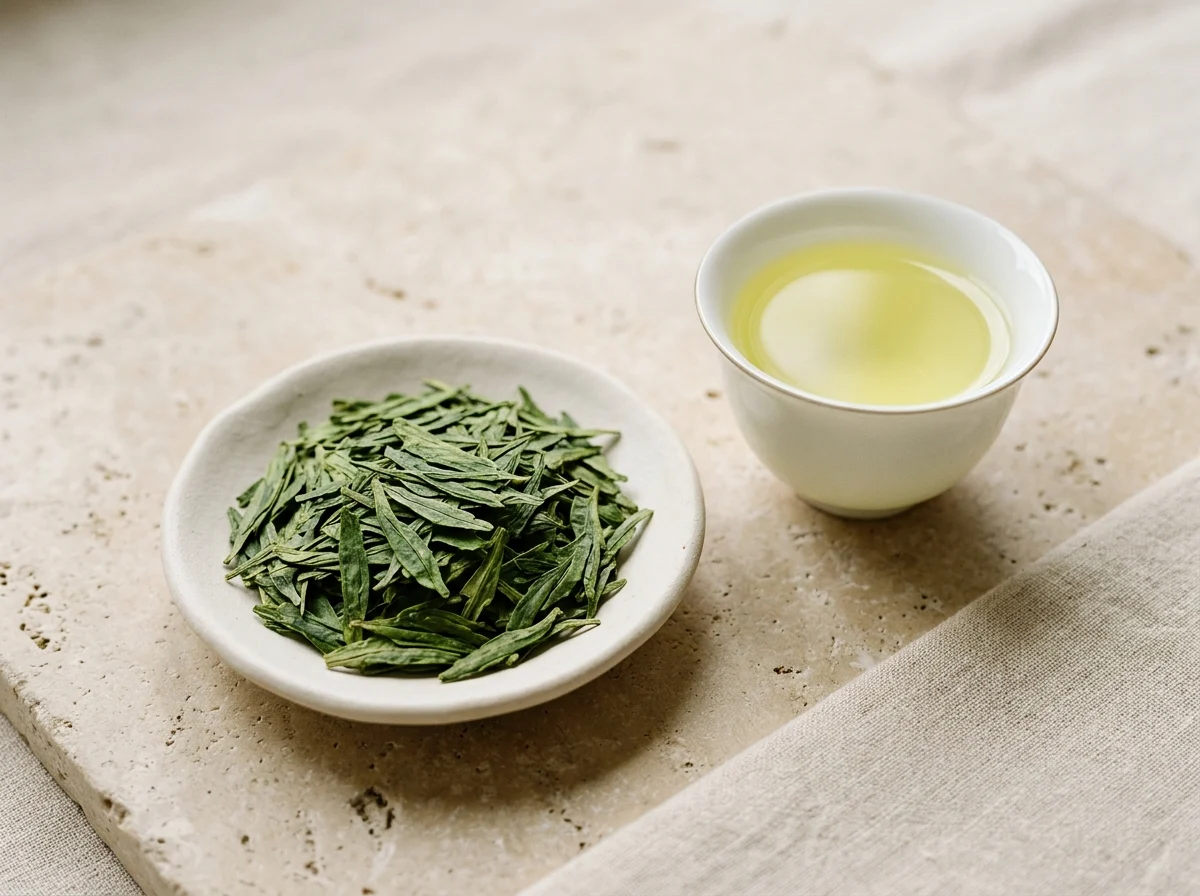
Dramatic long, flat olive-emerald blades (5–7 cm) clasping a central bud, often marked with faint screen embossing.
Brewed Liquor Color
Limpid pale jade with a soft golden-green gleam.
Aroma & Palate Profile
Clean wild orchid perfume ('Houkui rhyme') backed by sweet steamed snap-pea notes. — Remarkably gentle and full-flavored—unbroken cells yield smooth, sweet broth with lingering orchid lift.
Practical Buyer & Drinker Guide
Price Benchmarks, Authenticity Tips & Storage
Reference Price Range
Everyday lots ~$45–$85/500g; core Houkeng hand-pressed spring lots ~$150–$500+/500g
Authenticity & Buying Tips
Look for natural muted olive-jade with occasional maroon-tinged stems (a Shida cultivar trait); avoid neon-bright leaves or sharp perfume.
Home Storage Advice
Long blades fracture easily—store flat in rigid airtight foil tins under cool, dark refrigeration.
Related Teas in This Category
Clean toasted chestnut and warm bean aroma lifted by subtle spring orchid clarity in high-elevation lots.
Expressive orchard blossom and stone-fruit fragrance lifted by sweet downy pekoe notes.
Lifted wild mountain orchid fragrance backed by delicate downy sweetness.
Verified References & Provenance
- [01] 1979Source
Chen Chuan's Six-Category Tea Classification (1979) & Camellia sinensis Phylogeography
Chen Chuan (1979) / Chen Zongmao (ed., China Tea Classic)
Chen Chuan (1979) established the modern scientific taxonomy of six tea families based on processing mechanisms (enzyme inactivation, withering, yellowing, semi-oxidation, full oxidation, microbial piling) rather than linear fermentation; Chen Zongmao's China Tea Classic synthesizes modern agronomy and tea chemistry.
- [02] 2022Source
Traditional tea processing techniques and associated social practices in China
UNESCO Intangible Cultural Heritage · Nomination File No. 01884
Inscribed in 2022; documents the six core Chinese tea categories, reprocessed teas, and their embedded social rituals across 44 national heritage items.